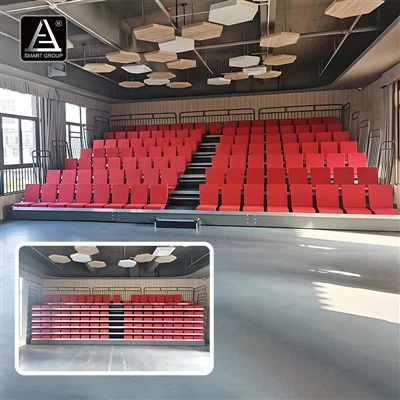
Sound insulation plays a crucial role in various settings, especially in stadiums where large crowds gather to watch events. As a leading supplier of aluminum grandstands, I am often asked about the sound insulation performance of our products. In this blog, I will delve into the factors that affect the sound insulation of aluminum grandstands, the measurement of sound insulation, and how our aluminum grandstands perform in terms of sound insulation.
Factors Affecting Sound Insulation of Aluminum Grandstands
The sound insulation performance of an aluminum grandstand is influenced by several factors. Let's take a closer look at each of them.
Material Composition
Aluminum, as the primary material of our grandstands, has certain acoustic properties. Aluminum is a relatively lightweight metal, and its density is lower compared to some other materials used for constructing buildings. Generally, denser materials tend to have better sound - blocking capabilities because they can more effectively impede the transmission of sound waves. However, our aluminum grandstands are not just made of pure aluminum. We often incorporate additional layers and materials to enhance their sound insulation. For example, some of our grandstands have a core layer of sound - absorbing materials such as fiberglass or mineral wool. These materials work by converting the kinetic energy of sound waves into heat energy as the sound waves pass through them, thus reducing the amount of sound that is transmitted through the grandstand structure.
Structural Design
The design of the aluminum grandstand can also significantly impact sound insulation. A well - designed grandstand with proper sealing and a continuous structure can prevent sound from leaking through gaps and joints. Our engineers pay special attention to the design of the connection points between different parts of the grandstand. We use high - quality gaskets and seals to ensure a tight fit, which helps to block the passage of sound. Additionally, the shape of the grandstand can affect the way sound waves interact with it. A curved or angled grandstand design can help to disperse sound waves, reducing the intensity of reflected sound and minimizing the accumulation of noise in one area.
Installation Quality
The quality of installation is another critical factor. If the grandstand is not installed correctly, there may be gaps or loose parts that can allow sound to escape or enter. Our installation teams are highly trained and experienced. They follow strict installation procedures to ensure that every component of the grandstand is properly installed and secured. This includes checking the alignment of panels, the tightness of bolts, and the integrity of the overall structure. By ensuring a high - quality installation, we can maximize the sound insulation performance of our aluminum grandstands.
Measuring Sound Insulation
To accurately assess the sound insulation performance of an aluminum grandstand, we use several standard measurement methods.
Sound Transmission Class (STC)
The Sound Transmission Class is a single - number rating that represents the ability of a partition (in this case, the grandstand structure) to block airborne sound. It is measured in a laboratory setting according to ASTM E90 and ASTM E413 standards. A higher STC rating indicates better sound insulation. For our aluminum grandstands, the STC rating can vary depending on the specific design and construction. Grandstands with more advanced sound - absorbing layers and better sealing can achieve relatively high STC ratings, which means they are more effective at reducing the transmission of sound from one side to the other.
Impact Insulation Class (IIC)
In addition to airborne sound, we also need to consider the impact of footfall and other impact noises on the grandstand. The Impact Insulation Class measures the ability of a floor or grandstand surface to reduce the transmission of impact - generated sound. It is measured according to ASTM E492 and ASTM E989 standards. Our grandstands are designed to have a good IIC rating. We use special flooring materials and structural designs to minimize the transfer of impact noise, providing a more comfortable environment for spectators.
Sound Insulation Performance of Our Aluminum Grandstands
Our company is constantly striving to improve the sound insulation performance of our aluminum grandstands. We understand that a quiet and comfortable environment is essential for spectators to enjoy their experience at stadiums.
Comparison with Traditional Materials
Compared with traditional grandstand materials such as concrete and steel, our aluminum grandstands have some unique advantages in terms of sound insulation. While concrete is a very dense material and can offer good sound - blocking properties, it is also heavy and difficult to install and modify. Steel, on the other hand, can transmit sound vibrations more easily, which may lead to more noise. Our aluminum grandstands, with their combination of sound - absorbing materials and well - designed structures, can achieve comparable or even better sound insulation performance in many cases. They also have the advantage of being lightweight, which makes them easier to install, relocate, and maintain.


Real - World Applications
In real - world stadium applications, our aluminum grandstands have shown excellent sound insulation performance. For example, in a recent football stadium project, the spectators reported that the noise from the outside was significantly reduced, allowing them to focus better on the game. The grandstand also helped to minimize the echo and reverberation inside the stadium, creating a more pleasant acoustic environment. Our Football Stadium Spectator Tribune Stand Aluminum Bleachers Seats are specifically designed for large - scale football stadiums, where sound control is of great importance.
Portable and Mobile Grandstands
We also offer Portable Aluminum Bleachers and Football Stadium Mobile Aluminum Bleachers Grandstand Seating with Roof. These types of grandstands are popular for their flexibility and ease of use. Despite their portability, we do not compromise on sound insulation. We use the same high - quality materials and advanced design techniques to ensure that they provide a satisfactory level of sound insulation. Whether it is a temporary event or a mobile stadium setup, our portable and mobile grandstands can effectively reduce noise and create a more comfortable environment for spectators.
Conclusion and Call to Action
In conclusion, the sound insulation performance of our aluminum grandstands is a result of careful material selection, innovative design, and high - quality installation. We are committed to providing our customers with grandstands that not only offer excellent structural integrity but also superior sound insulation.
If you are in the market for an aluminum grandstand and are interested in learning more about our products' sound insulation performance or have any other questions, we encourage you to reach out to us. We are here to discuss your specific needs and provide you with a customized solution that meets your requirements.
References
- ASTM E90 - Standard Test Method for Laboratory Measurement of Airborne Sound Transmission Loss of Building Partitions and Elements.
- ASTM E413 - Classification for Rating Sound Insulation.
- ASTM E492 - Standard Test Method for Laboratory Measurement of Impact Sound Transmission Through Floor - Ceiling Assemblies Using the Tapping Machine.
- ASTM E989 - Classification for Rating Impact Sound Insulation.