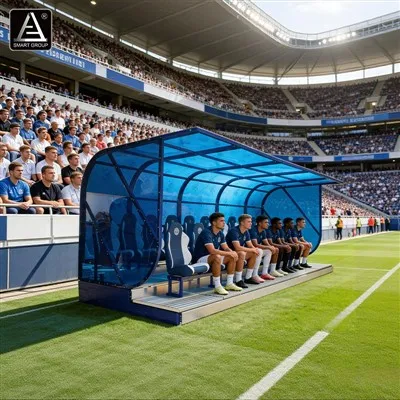
GLOBAL NEWSWIRE - As global climate patterns shift, coastal regions are experiencing more frequent and severe tropical cyclones. For sports stadium developers and municipal planners, ensuring the structural integrity of outdoor equipment has become a top priority. Among these, sports team substitute benches (team shelters) with large-radius Polycarbonate (PC) endurance board canopies are particularly vulnerable to extreme wind loads due to their aerodynamic profiles.
How do manufacturers ensure these structures survive category 12+ typhoons? What should international buyers look for during procurement? This industry report breaks down the critical wind resistance calculations and procurement benchmarks for high-risk coastal zones.
The Physics of Defying Typhoons: Wind Resistance Structural Calculations
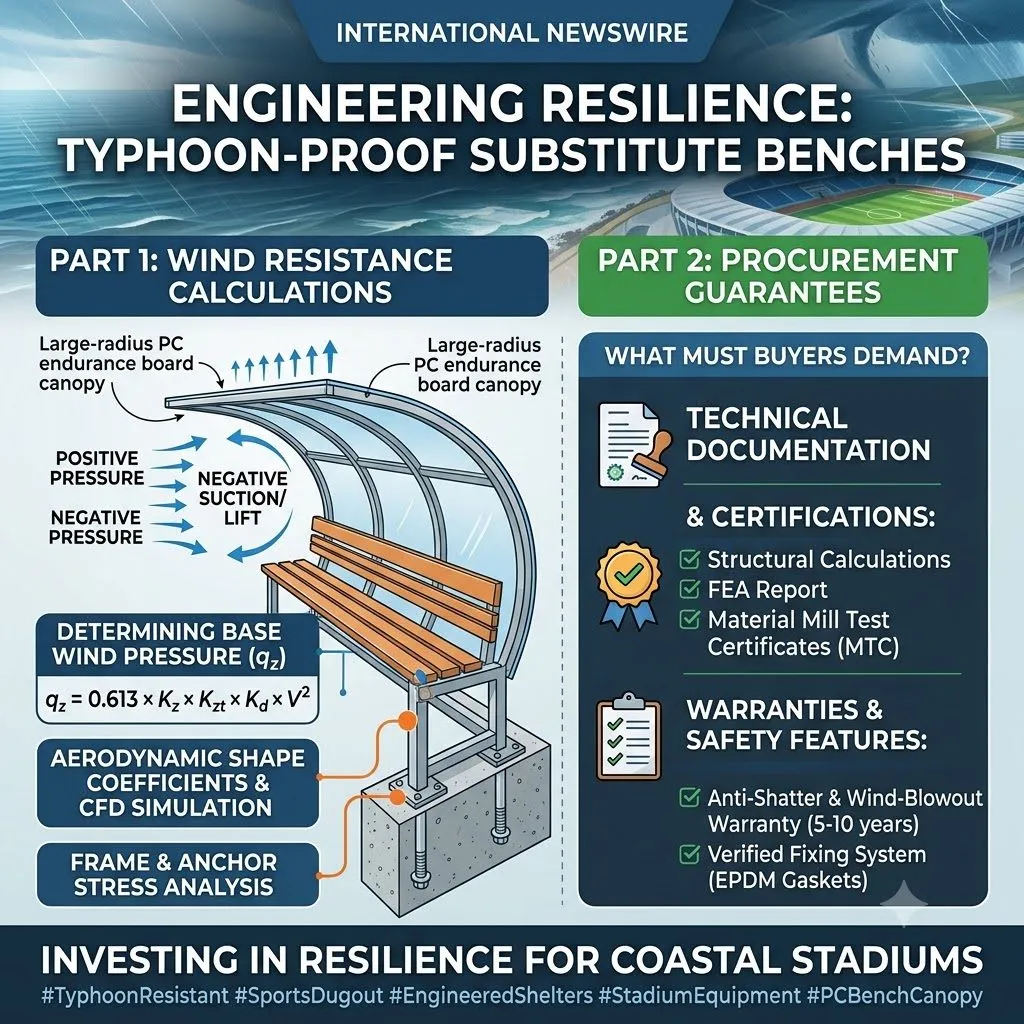
Large-radius PC endurance board canopies act like inverted airplane wings. In high-wind scenarios, they don't just experience frontal pressure; they suffer from massive aerodynamic lift (suction) and vortex shedding.
To prevent the canopy from tearing away or collapsing, structural engineers employ rigorous calculations based on international standards (such as ASCE 7 in the US, Eurocode 1, or GB 50009 in China).
Step 1: Determining the Base Wind Pressure
Engineers calculate the peak velocity pressure (qz) using the regional basic wind speed (V), which in coastal typhoon zones often exceeds 45–50 m/s:
qz = 0.613 x Kz x Kzt x Kd x V2
Where:
Kz is the velocity pressure exposure coefficient.
Kzt is the topographic factor.
Kd is the wind directionality factor.
Step 2: Aerodynamic Shape Coefficients (μ8) & Finite Element Analysis (FEA)
Because "large-radius" curves alter airflow, standard textbook coefficients aren't enough. Advanced manufacturers use CFD (Computational Fluid Dynamics) to simulate how wind wraps around the curve.
· Windward Pressure: The windward side experiences positive pressure trying to crush the frame.
· Leeward/Lift Suction: The curved top experiences massive negative pressure (lift). The PC sheet fastening system must be calculated to resist pulling out of its aluminum or steel rivets.
Step 3: Frame and Anchor Stress Analysis
The calculation must prove that the stress on the structural steel or aluminum frame-and crucially, the chemical anchor bolts embedded in the concrete foundation-does not exceed the material's yield strength under maximum load combinations.
Procurement Checklist: What Guarantees Must Buyers Demand?
When sourcing substitute benches for coastal or island projects, relying on a vendor's verbal promise of "heavy-duty" is a liability. International buyers should demand a verified compliance package before signing a contract.
📋 Technical Documentation & Certifications
· Stamped Structural Calculation Sheet: A comprehensive report signed by a certified structural engineer (PE) proving the bench assembly can withstand the specific wind speed of your target region (e.g., 160 mph / 260 km/h).
· Finite Element Analysis (FEA) Report: Visual proof of stress distribution on the PC board and metal skeleton under typhoon conditions.
· Material Mill Test Certificates (MTC): * For the Canopy: Proof that the PC endurance board is virgin material (not recycled) with co-extruded UV protection to prevent embrittlement under coastal sun and salt spray.
· For the Frame: Proof of steel grade (e.g., Q235B/Q355B) or Aluminum alloy (e.g., 6061-T6) and hot-dip galvanization or marine-grade powder coating thickness.
Warranties & Safety Features
· Anti-Shatter & Wind-Blowout Warranty: A minimum 5-to-10-year warranty specifically covering PC board cracking, yellowing, or structural blowout due to wind loads within the design limit.
· Fixing System Guarantee: Verification that the PC board is secured using EPDM gaskets and continuous aluminum clamping profiles, rather than simple exposed screws which tear through the plastic under high winds.
Why Manufacturer Expertise Matters
A sports substitute bench is no longer just a piece of street furniture; in modern sports architecture, it is a localized engineered structure. Working with a manufacturer that integrates CFD simulation, precision structural calculation, and marine-grade materials ensures that your stadium assets remain anchored, intact, and safe-even when the storm of the century hits the coast.
Author Profile: Guangzhou Smart Sports Industrial Co., Ltd.