A football club's locker room is far more than just a physical space for changing gear; it is the heart of the team, a spiritual sanctuary, and a tactical fortress. A well-designed locker room can profoundly impact the team's cohesion and performance.
Physical Space, Scale, and Specifications
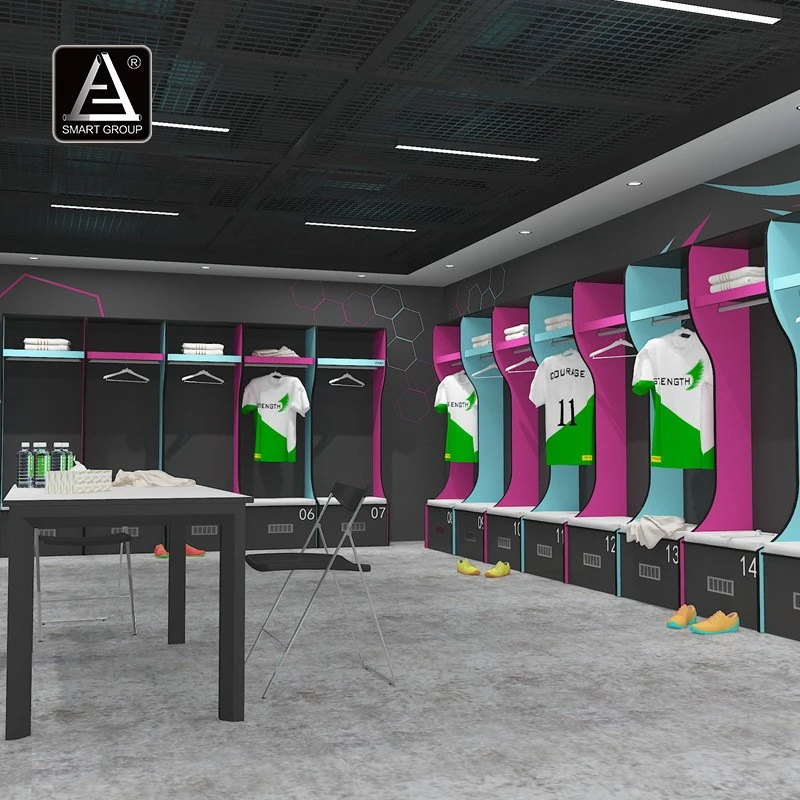
A standard top-tier club locker room typically covers an area of 60 to 100 square meters or more. Its core area is often arranged in a circular or U-shaped layout, ensuring every player can see each other and the coach in the center unobstructed when seated. Each player has a spacious, ergonomic personal seat, usually equipped with soft leather cushions and backrests, with a jersey bearing their name and number hanging above. Individual lockers are provided in front of each seat for personal belongings; custom-designed shoe compartments are below, and hooks are on the sides. The central space is sufficiently spacious to accommodate a tactical moving board and small meeting chairs. Furthermore, this space is typically adjacent to areas like massage zones, hydrotherapy pools, showers, and toilets, forming a fully-equipped, private complex.
Advantages and Characteristics
Its greatest advantage lies in strengthening team identity and focus. The U-shaped design eliminates any sense of hierarchy, symbolizing unity and equality. Professional acoustic design (such as sound-absorbing wall panels and ceilings) ensures the privacy of tactical briefings and blocks out external distractions. Rational circulation planning allows players to move efficiently before the match, at halftime, and after the game, enabling seamless transitions from preparation and instruction to recovery.
Application Scenarios
Its use is continuous: Pre-match, it is the battlefield for building morale and final deployments; Halftime, it is the emergency room for crucial adjustments and regrouping; Post-match, it is the shared space for collective celebration or analysis and reflection. On non-match days, it also serves as the central venue for team meetings and internal communication.
Materials and Craftsmanship
Material selection relentlessly pursues durability, comfort, and a sense of luxury. Player seats often use top-grain leather or high-performance, antimicrobial algae-based materials; lockers are made from solid wood or high-strength composite panels, exuding a sense of solidity and quality; the flooring is laid with anti-slip, resilient advanced epoxy resin or commercial-grade carpeting. All details, from the stitching to the hardware, reflect exquisite craftsmanship and lasting quality.
Customizable Logo
The club's crest (logo) is the soul of the space and can be customized in several key locations: most prominently, inlaid into the central carpet, serving as the visual focal point; it can also be engraved or etched onto each locker door and featured on a large club emblem decorating the main wall; even intricately embroidered on the headrest of each player's seat, constantly reinforcing brand identity and a sense of belonging.
Applicable Clubs
Such high-end locker rooms are suitable for all ambitious football organizations: from professional clubs in Europe's top leagues (like Real Madrid, Bayern Munich, Manchester United) to emerging powerhouses and traditional teams with deep heritage; they are also applicable for national team training centers, well-established youth academies, and any football institution aiming to build world-class facilities to attract top talent. It is not merely a room but the physical declaration of a club's ambition and professional ethos.
Author Profile:Guangzhou Smart Sports Industrial Co., Ltd.