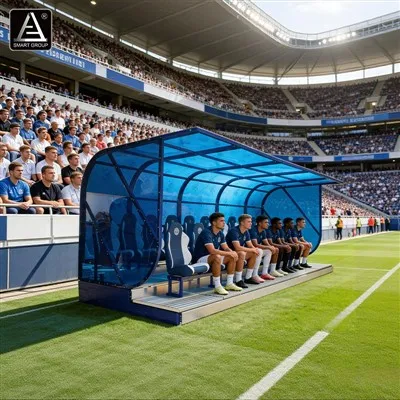
When designing or upgrading an outdoor sports venue, one of the most critical decisions is selecting the right seating material. As a leading manufacturer of aluminum bleachers, we often receive questions from facility managers: How do High-Density Polyethylene (HDPE) blow-molded seats compare to aluminum alloy seats regarding UV resistance and fire safety?
Both materials are industry standards, but they perform differently under environmental stress and safety testing. In this guide, we will break down their performance to help you make an informed investment that balances safety, durability, and cost-effectiveness.
UV Resistance and Color Fastness: Fighting the Sun
Outdoor bleachers are constantly exposed to harsh sunlight. Ultraviolet (UV) radiation is the primary enemy of seating longevity, leading to "chalking," brittleness, and fading.
HDPE Blow-Molded Seats
High-Density Polyethylene is a polymer. By nature, plastics are sensitive to UV rays, which can break down the molecular bonds. However, professional-grade HDPE seats are engineered with UV stabilizers (such as UV-8 or UV-15 additives) during the blow-molding process.
Performance: High-quality HDPE seats can maintain their structural integrity and color for 5–10 years depending on the UV intensity of your region.
The Downside: Over time, even with stabilizers, plastic will eventually undergo molecular degradation. In high-UV areas like Australia, the Middle East, or the Southwestern United States, "fading" is inevitable after a decade of exposure, and the plastic may become prone to cracking under heavy impact.
Aluminum Alloy Seats
Aluminum is a metallic element and is inherently immune to UV degradation. It does not contain carbon-to-carbon bonds that UV light can break.
Performance: Whether it is clear-anodized or powder-coated, aluminum does not crack, peel, or become brittle under sunlight. Anodized aluminum reflects a significant portion of UV radiation rather than absorbing it.
The Advantage: From a manufacturer's perspective, aluminum is the "set it and forget it" choice for UV resistance. It offers a lifespan of 20+ years without the risk of sun-induced structural failure, making it the superior choice for high-altitude or tropical climates.


Fire Retardant Ratings: The Safety Benchmark
In public assembly spaces, fire safety is non-negotiable. Building codes often require materials to meet specific flame spread and smoke development indices to ensure spectator safety during emergencies.
HDPE Seats (Fire Retardant Additives)
Standard HDPE is a flammable petroleum-based product. To meet safety standards (like UL94, ASTM E84, or EN 13501), manufacturers must incorporate Flame Retardant (FR) masterbatches.
Ratings: High-end HDPE seats can achieve a Class B or even Class A fire rating. This means they will self-extinguish once the heat source is removed and have a controlled flame spread rate.
Risk Factor: In an intense, sustained fire, HDPE will eventually melt and can produce heavy smoke. It is essential to verify that your supplier provides certified test reports for "Anti-Static" and "Flame Retardant" properties before purchase.
Aluminum Alloy Seats (Non-Combustible)
Aluminum is classified as a non-combustible material. It does not burn and has a melting point of approximately 660℃(1,220°F)
Ratings: Aluminum planks naturally exceed the requirements for Class A fire ratings without any additional chemical treatment. It does not ignite, nor does it contribute to the fuel load of a fire.
Safety Advantage: In the event of an emergency, aluminum seating provides a safer environment because it produces zero toxic smoke. This is often a mandatory requirement for indoor arenas, underground facilities, or enclosed grandstands where smoke inhalation is a major concern.
Maintenance and Long-term Durability
Beyond UV and fire, the "Total Cost of Ownership" (TCO) is heavily influenced by how these materials age and the maintenance they require.
HDPE Maintenance: Blow-molded seats have a hollow interior. While they are lightweight and easy to replace individually, they can sometimes trap moisture if the drainage holes become clogged. Cleaning typically requires mild soap and high-pressure water. However, as the plastic ages and becomes more porous due to UV exposure, it can become harder to remove deep-seated dirt or graffiti.
Aluminum Maintenance: Aluminum is virtually maintenance-free. Its naturally occurring oxide layer protects it from rust and corrosion. For venues near the ocean, we recommend anodized aluminum, which withstands salt-spray corrosion far better than any polymer or coated steel. The primary maintenance task is simply checking the hardware (bolts and nuts) to ensure they remain tight after years of thermal expansion and contraction.
Climate Adaptability: Heat and Cold
A common concern is how these materials feel to the touch in extreme weather.
· Extreme Heat: Aluminum has high thermal conductivity. In direct 100°F sunlight, aluminum planks can become hot. However, because it is thin and reflective, it also loses heat very quickly once shaded or sat upon. HDPE has low conductivity; it takes longer to heat up but also longer to cool down.
· Extreme Cold: In sub-zero temperatures, some plastics can become "cold-brittle" (the glass transition effect). Aluminum remains ductile and strong even in Arctic conditions, which is why it is the standard for ski resort bleachers.
Comparison Summary Table
| Feature | HDPE Blow-Molded Seats | Aluminum Alloy Seats |
| UV Resistance | Good (Requires additives) | Excellent (Inherent) |
| Fire Safety | Flame Retardant (FR) | Non-combustible (Class A) |
| Lifespan | 8–12 Years | 20+ Years |
| Smoke Toxicity | Potentially High | Zero |
| Corrosion Resistance | Excellent | Exceptional (especially Anodized) |
| Impact Resistance | High (while new) | Extremely High |
Frequently Asked Questions (FAQ)
Q: Can HDPE seats be recycled?
A: Yes, HDPE is highly recyclable (Plastic #2). However, seats with flame-retardant additives may need specialized processing compared to standard household plastics.
Q: Does aluminum seating rust?
A: No. Unlike steel, aluminum produces a protective oxide layer that prevents red rust. It is ideal for humid or coastal environments.
Q: Are HDPE seats more comfortable than aluminum?
A: Generally, yes. Blow-molded HDPE allows for ergonomic, contoured designs and backrests, whereas aluminum bleachers are usually flat planks. For high-comfort VIP sections, HDPE is often preferred.
Conclusion: Which is Right for Your Project?
As a specialized manufacturer, we recommend choosing based on your specific project priorities:
Choose HDPE Blow-Molded Seats if: You are building a high-end stadium where spectator comfort and team branding (colors) are the top priorities. They are perfect for "individual bucket seating" layouts.
Choose Aluminum Alloy Seats if: You are looking for a "generational investment." If the bleachers are for a school, fairground, or public park where fire safety, zero maintenance, and 20-30 years of durability are required, aluminum is the undisputed winner.
Are you planning a bleacher project? Our engineering team can help you navigate local fire codes and UV requirements to choose the perfect material. Contact us today for a free consultation and a detailed project quote.
Author Profile:Guangzhou Smart Sports Industrial Co., Ltd.