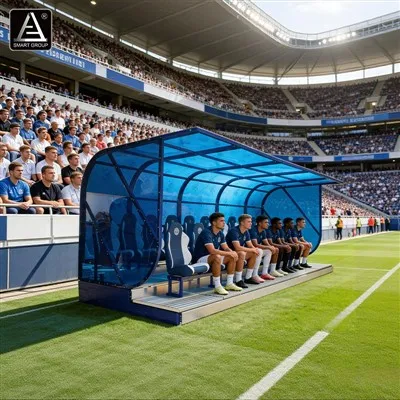
For builders of open-air stadiums, school playgrounds, and large event venues, the material and manufacturing process of grandstand seats directly determine the project's final appearance and long-term maintenance costs. Especially in regions with extreme climates, featuring heavy rain and intense sun exposure, problems like UV-accelerated aging, acid rain corrosion, and high-temperature deformation impose extremely rigorous tests on stadium seats.
Currently, mainstream outdoor grandstand seats in the market are primarily divided into two types: hollow blow molding and injection molding. Which process is more suitable for rainy and sunny areas? This article will provide an in-depth analysis across five core dimensions: UV resistance, aging resistance, fire resistance, chemical corrosion resistance, and lifespan.
Comparison of Process Principles and Base Material Differences
Before diving into the performance comparison, let's establish an intuitive physical concept:
· Hollow Blow Molding Process (Blow Molding): Extrude a hot-melt plastic parison (tube), close the mold, and inject compressed air to blow it up against the mold cavity, cooling it into shape. Its core characteristic is a double-layer, hollow structure, and it often uses High-Density Polyethylene (HDPE) as the raw material.
· Injection Molding Process (Injection Molding): Inject molten plastic into a closed mold cavity under high pressure. After cooling, it yields a solid or single-layer product with reinforcing ribs. It commonly uses Polypropylene (PP) or modified polyethylene.
Overview Table of Comprehensive Performance Comparison

"Hardcore" Showdown of 5 Core Performances
1. UV Resistance and Aging Resistance
In environments with long-term exposure to sunlight, UV radiation is the number one "killer" of polymer materials.
· Hollow Blow-Molded Seat (Winner): The HDPE material primarily used in blow-molded seats has a dense molecular chain structure itself, possessing naturally excellent weather resistance. More importantly, the unique double-layer hollow structure of blow-molded seats acts as a natural "air insulation layer." Under intense sun exposure, after the outer layer heats up, the hollow sandwich layer can effectively slow down the conduction of heat to the inner side and the overall structure, preventing the seat from accelerating thermal-oxidative aging due to excessive localized high temperatures.
· Injection-Molded Seat: The PP material commonly used in injection molding is relatively sensitive to UV rays. Under long-term strong UV irradiation, if an efficient light stabilizer is not added in sufficient quantities, the PP molecular chains are prone to degradation and breakage, leading to fading of the seat surface, pulverization of precipitates, and brittleness. Additionally, its single-layer solid structure conducts heat quickly, and the overall material experiences greater temperature difference stress.
2. Coping with Rainy Environments and Chemical Corrosion Resistance
Rainy areas are accompanied not only by high humidity but also by acid rain and salt spray corrosion in coastal areas.
· Hollow Blow-Molded Seat (Winner): The surface of the blow-molded seat is smooth with rounded lines. Typically, in the design stage, a concealed central drainage hole is pre-reserved in the low-lying area of the seat surface, allowing accumulated water after rain to drain quickly. At the same time, HDPE has extremely strong chemical inertness towards acids, alkalis, salt spray, and daily stadium disinfectant cleaning agents. It never absorbs water, completely eliminating material internal hydrolysis caused by moisture penetration.
· Injection-Molded Seat: To ensure load-bearing strength, injection-molded seats typically feature dense, grid-like reinforcing ribs (Ribs) on their back. In environments that are rainy, humid, and with poor air circulation, these dense reinforcing rib grooves are extremely prone to accumulating water and trapping silt. Over time, they will breed mold and moss, increasing the difficulty of later manual cleaning and maintenance.
3. Fire Resistance (Flame Retardant Rating)
· Draw: Whether it's HDPE or PP, the base material itself falls within the flammable range. In actual production, the fire resistance of stadium seats (usually required to reach the Chinese National Standard B1 flame retardant rating) mainly depends on the formulation of flame retardant masterbatch and the processing technology. Whether it's blow molding or injection molding, as long as sufficient efficient halogen-free flame retardant is added strictly according to standards, an excellent self-extinguishing effect upon leaving the flame can be achieved. However, in the dimension of thermal deformation, the double-wall structure of blow molding can maintain structural integrity for a longer time when exposed to fire compared to single-layer thin-wall injection-molded parts.
4. Structural Strength and Impact Resistance
· Hollow Blow-Molded Seat (Winner): Open-air grandstand seats often need to withstand spectators' trampling, impact, and even vandalism. A hollow blow-molded seat acts like a "high-strength air cushion," possessing excellent impact toughness. Under internal stress changes caused by extreme temperature differences (daytime scorching high temperatures, nighttime heavy rain, and sudden cooling), the blow-molded structure is not prone to stress cracking (possessing excellent Environmental Stress Cracking Resistance, ESCR performance).
· Injection-Molded Seat: Injection-molded seats have a rigid structure. While high in rigidity, after material localized embrittlement caused by long-term sun exposure, once subjected to powerful impact or trampling, they are extremely prone to brittle fracture at the junction of reinforcing ribs and wall thickness (stress concentration point), forming sharp fragments and presenting a safety hazard.
5. Comprehensive Lifespan
· Conclusion: In rainy and sunny areas, the actual outdoor lifespan of hollow blow-molded seats is significantly better than that of ordinary injection-molded seats.
· High-quality modified hollow blow-molded stadium seats, under open-air extreme climates, can typically achieve a high-light efficiency lifespan of over 8-10 years, maintaining good mechanical strength and color vividness;
· Whereas ordinary injection-molded seats, under the same harsh outdoor environment, usually exhibit varying degrees of aging, embrittlement, and fading after about 3-5 years.
Summary and Procurement Advice
In summary, hollow blow-molded stadium seats are significantly superior to injection-molded seats in UV resistance, aging resistance, acid rain corrosion resistance, and long-term open-air lifespan. It is the best technical solution for coping with global extreme open-air climates such as heavy rain, intense sunlight, and high salt spray. Meanwhile, injection-molded seats, with their high precision and rich detail expressiveness, are more suitable for application in indoor stadiums with roofs, auditoriums, or semi-indoor grandstands with small temperature changes.
As a professional stadium plastic seat manufacturer, we possess a mature polymer-modified hollow blow molding production line and have specifically developed an upgraded weather-resistant, UV-resistant, and flame-retardant formula for regions with heavy rain and intense sun exposure. If you are looking for a high-cost-performance, low-maintenance seat solution for your open-air stadium project, feel free to contact us to obtain customized plans and sample sending services!
Author Profile: Guangzhou Smart Sports Industrial Co., Ltd.