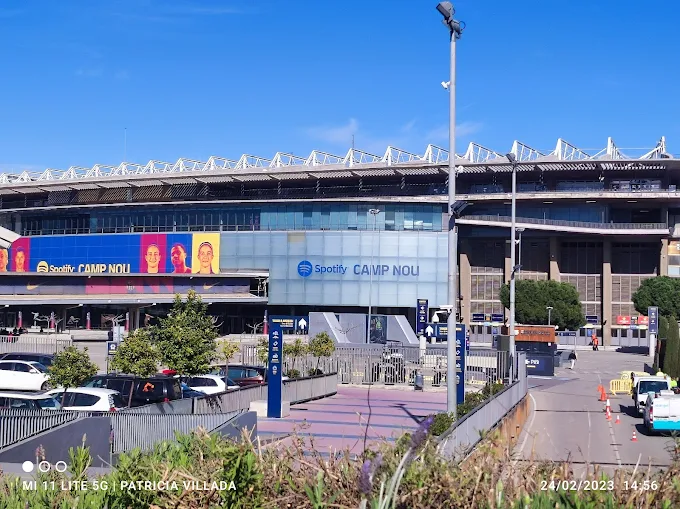
For football fans around the globe, certain venues are more than just sports arenas; they are veritable cathedrals of the beautiful game. At the absolute pinnacle of this list sits Camp Nou (currently known as Spotify Camp Nou due to sponsorship), the legendary home of FC Barcelona. As the largest stadium in Europe and the second-largest association football stadium in the world, Camp Nou is a masterpiece of sporting architecture and a monumental landmark in Catalonia, Spain.
Whether you are a die-hard Blaugrana supporter, an architecture enthusiast, or a traveler planning a bucket-list trip to Barcelona, understanding the rich history, immense scale, and cultural heartbeat of this venue is essential. Here is an in-depth exploration of the construction history, architectural design, and legendary legacy of Camp Nou.
The Historical Background: Built for a Legend
The story of Camp Nou begins in the early 1950s, driven by a blend of ambition and necessity. At the time, FC Barcelona played their home matches at the Camp de Les Corts. Although Les Corts was a respectable stadium that had been expanded several times to hold 60,000 spectators, it simply could not keep up with the club's surging popularity.
The primary catalyst for building a new stadium was the arrival of the legendary Hungarian forward, Ladislao Kubala, in 1950. Kubala's spectacular performances and charisma led to a massive influx of fans; almost every match was a total sell-out, leaving thousands of supporters stranded outside. Realizing that further expansion of Les Corts was physically impossible due to the surrounding urban density, the club's board, led by President Francesc Miró-Sans, commissioned a brand-new, colossal stadium. The first stone was officially laid on March 28, 1954, marking the beginning of a three-year construction odyssey that would redefine the city's skyline.
Architects and the Engineering Marvel
To bring this ambitious vision to life, FC Barcelona hired a team of brilliant local minds. The stadium was designed by head architects Francesc Mitjans Miró (a cousin of President Miró-Sans) and Josep Soteras Mauri, in collaboration with Lorenzo García-Barbón.
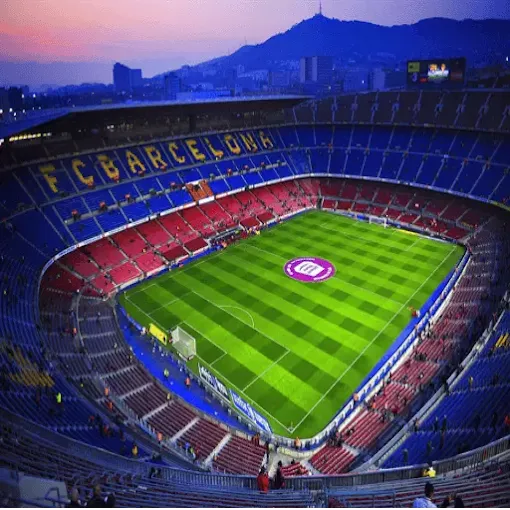
Their design was revolutionary for its time. Rather than a traditional rectangular stadium, they opted for a sweeping, symmetrical bowl that prioritized excellent sightlines from every angle. The construction was awarded to the firm INGAR S.A. The project was an immense engineering challenge. By the time Camp Nou officially opened on September 24, 1957 (the day of La Mercè, Barcelona's patron saint), the final cost had skyrocketed to a staggering 288 million pesetas-over 300% more than the original estimate. This debt burdened the club for years, but it secured their status as a European powerhouse.
Unmatched Capacity: The Giant of Europe
When discussing Camp Nou, its sheer size is always the headline. It holds the prestigious title of being the largest stadium in Europe.
Historical Peak: For the 1982 FIFA World Cup, the stadium was expanded to accommodate an incredible 120,000 fans. During this era, the stadium included large standing areas (terraces), creating an atmosphere that was both electric and intimidating.
Modern Seating: In the late 1990s, UEFA introduced strict safety regulations requiring all major stadiums to be all-seaters. This forced Barcelona to remove the terraces, bringing the capacity to its pre-renovation figure of 99,354.
The Future (Espai Barça): The stadium is currently undergoing a massive €1.45 billion transformation. Upon completion, the capacity will rise to 105,000, and for the first time in history, all seats will be covered by a massive 30,000-square-meter roof.
Architectural Features and Cultural Identity
Camp Nou is instantly recognizable thanks to several distinct architectural and symbolic features:
The "Més Que Un Club" Philosophy
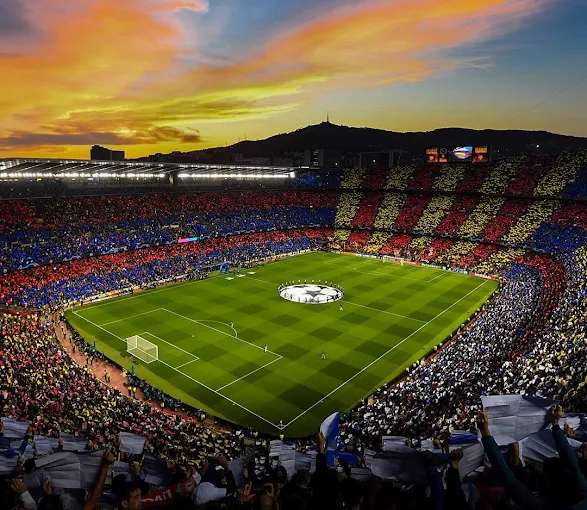
Looking across the pitch from the main grandstand, the seats in the opposite tier are famously colored in the club's blue and garnet (blaugrana) hues, spelling out the club's powerful motto: "Més que un club" (More than a club). This reflects the stadium's role as a symbol of Catalan identity and resistance during the Franco era.
Brutalist Elegance
Architecturally, the stadium is a prime example of mid-century functionalism with Brutalist influences. The exposed concrete ribs and the cantilevered canopy over the presidential box were highly advanced for the 1950s. The bowl is "sunk" into the ground, meaning that from the outside, the stadium appears much smaller than it actually is; the true scale is only revealed once you walk through the tunnels and emerge into the stands.
The Pitch of Dreams
The grass at Camp Nou is notoriously pristine. Often referred to as a "pool table," the pitch dimensions are 105 x 68 meters, providing the wide-open spaces necessary for Barcelona's signature "Tiki-Taka" passing style, pioneered by Johan Cruyff and perfected by Pep Guardiola.
A Stage for Global History: Notable Events
Over the decades, Camp Nou has hosted much more than just domestic league games. It has been the stage for some of the most dramatic moments in human history:
1982 FIFA World Cup: It hosted the opening ceremony and five matches, including the semi-final between Poland and Italy.
1992 Summer Olympics: The stadium was the crown jewel of the Barcelona Olympics, hosting the football final where Spain won the gold medal.
The 1999 UEFA Champions League Final: Often cited as the greatest comeback in football history, Manchester United scored twice in "Fergie Time" (stoppage time) to snatch the trophy from Bayern Munich.
The Messi Era: For nearly two decades, Camp Nou was the playground for Lionel Messi, arguably the greatest player to ever play the game, who scored hundreds of goals and broke countless records on this turf.
Beyond Football: Concerts and Culture
Camp Nou's massive capacity has made it a premier venue for global superstars. It has hosted legendary concerts by:
Michael Jackson (Bad World Tour, 1988)
U2 (360° Tour, 2009)
Bruce Springsteen
Pope John Paul II (Who celebrated mass for 120,000 people in 1982)
The New Era: Spotify Camp Nou and Limak Construction
Currently, the stadium is in a state of evolution. The Espai Barça project is being led by the Turkish construction giant Limak Construction. This project is not just a renovation but a total modernization. It will feature a 360-degree giant screen inside the bowl, massive solar panels on the roof to power the facility, and a new "Sky Walk" allowing fans to walk on top of the roof for panoramic views of Barcelona.
Camp Nou is not just a building made of concrete and steel; it is the beating heart of Barcelona. Its rich construction history, visionary architectural design, and record-breaking capacity make it a true temple of world football. As it transitions into its next phase as the most modern stadium in the world, its legacy as a site of passion, politics, and unparalleled sporting excellence remains firmly intact.
For any traveler to Spain, a visit to the Camp Nou Museum and a walk through its hallowed tunnels is a journey through the very history of football itself.
Author Profile: Guangzhou Smart Sports Industrial Co., Ltd.