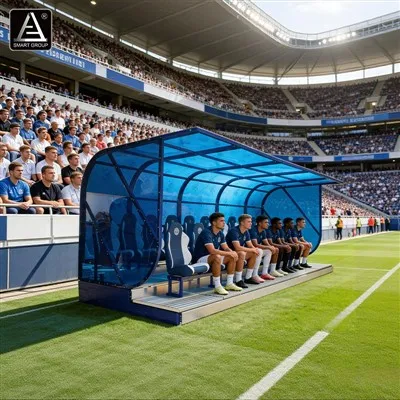
In stadiums, schools, sports halls, and multi-purpose venues, seating systems play a crucial role in both spectator experience and space efficiency. Two of the most common solutions are retractable bleachers (telescopic seating systems) and fixed grandstands. While they may serve the same basic purpose-providing seating for audiences-their structure, functionality, cost, and use scenarios differ significantly. Understanding these differences helps facility owners make a more efficient and long-term investment decision.
Structural Design: Mobility vs Permanent Installation
The most fundamental difference lies in the structural design.
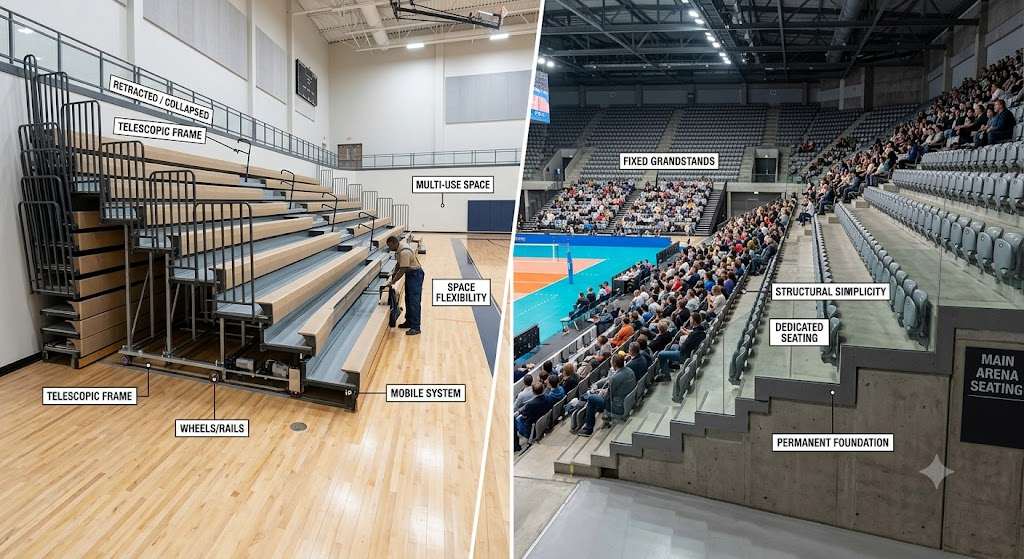
Retractable bleachers are engineered as a movable, foldable seating system that can extend or collapse depending on event needs. They typically use a telescopic frame system with wheels, rails, or motorized mechanisms, allowing the entire seating block to be stored compactly against a wall when not in use.
In contrast, fixed bleachers or fixed grandstands are permanently installed structures anchored to the building foundation or ground. They are built using steel or reinforced concrete frameworks and are designed to remain in place for decades without relocation or adjustment.
This difference directly impacts how each system interacts with venue space and usage flexibility.
Space Utilization and Flexibility
Space efficiency is where retractable bleachers clearly stand out.
Retractable seating systems are ideal for multi-functional venues such as school gymnasiums, indoor sports courts, and exhibition halls. When the seating is retracted, the open floor can be used for training, events, trade shows, or community activities. This "dual-use space" concept significantly increases the value of a single facility.
Fixed grandstands, however, dedicate the space permanently to spectator seating. While this is perfect for stadiums or arenas with continuous audience demand, it limits the ability to repurpose the area. Once installed, the layout remains unchanged, which can reduce operational flexibility in smaller or multi-use venues.
Cost Considerations and Long-Term Investment
From a budgeting perspective, both systems serve different financial strategies.
Retractable bleachers usually require a higher initial investment due to their mechanical components, structural precision, and optional automation systems. However, they can reduce the need for constructing larger buildings, since one space can serve multiple purposes.
Fixed grandstands generally have a lower installation cost per seat, especially when built with precast concrete or standard steel frameworks. They are more cost-efficient for large-scale stadiums where seating demand is constant and space flexibility is not required.
In the long term, the choice depends on usage frequency and venue type rather than price alone.
Safety, Durability, and Maintenance Requirements
Safety standards for both systems are strict, but their maintenance needs differ.
Retractable bleachers require regular inspection of mechanical parts such as locking systems, motors (if electric), wheels, and rails. Proper maintenance ensures smooth operation and prevents structural misalignment. When well-maintained, they meet high international safety standards for dynamic seating systems.
Fixed grandstands are structurally simpler and generally require less frequent mechanical maintenance. However, they still need periodic checks for corrosion, concrete integrity, and seat condition, especially in outdoor environments exposed to weather conditions.
In terms of durability, fixed systems often have a longer structural lifespan due to their permanent foundation, while retractable systems rely more on mechanical longevity.
Application Scenarios: Choosing the Right System
Retractable bleachers are commonly used in:
· School gymnasiums
· Indoor sports halls
· Multipurpose community centers
· Training facilities and exhibition venues
Their strength lies in adaptability and efficient space conversion.
Fixed grandstands are typically used in:
· Football and soccer stadiums
· Athletics tracks
· Outdoor sports arenas
· Large-scale public venues
They are best suited for environments where spectator seating is always required and space transformation is not necessary.
How to Decide Between the Two Systems
Choosing between retractable and fixed seating depends on three key factors: space usage, event frequency, and budget strategy.
If your venue hosts multiple types of events and requires flexible floor space, retractable bleachers offer a highly efficient solution. If your facility is designed primarily for large-scale sports events with consistent attendance, fixed grandstands provide better long-term simplicity and durability.
In many modern sports complexes, a hybrid approach is also emerging-combining fixed seating for main spectator zones with retractable systems in auxiliary halls.
Conclusion
Retractable bleachers and fixed grandstands each offer distinct advantages shaped by their structural design and intended use. Retractable systems prioritize flexibility and space efficiency, while fixed seating emphasizes permanence and long-term stability. Understanding these core differences ensures better planning, optimized investment, and a more functional spectator experience for any sports or event facility.
Author Profile: Guangzhou Smart Sports Industrial Co., Ltd.