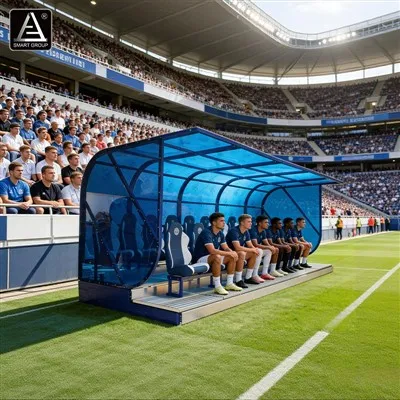
In the construction and upgrade of school sports venues and outdoor grandstands, the choice of seating material directly impacts the school's long-term operational costs and campus safety. Especially in regions with freezing winters where temperatures easily drop to -20°C or -30°C, outdoor facilities face a harsh "ultimate test."
Many school procurement officers often face a dilemma when choosing between hollow blow-molded chairs and aluminum alloy benches (connected long benches): From a long-term maintenance perspective, which material has a lower damage rate in freezing winters?
This article provides an in-depth analysis of this core question from three dimensions: material science, actual application scenarios, and maintenance costs.
Hollow Blow-Molded Chairs: "Elasticity and Hidden Risks" in Low-Temperature Environments
Hollow blow-molded chairs are currently one of the most common choices for school outdoor grandstands. Their primary material is usually High-Density Polyethylene (HDPE), with anti-ultraviolet (UV) and anti-aging additives.
1. Performance in Freezing Cold
High-density polyethylene itself possesses excellent low-temperature resistance, with a brittleness temperature generally reaching below -70°C. Therefore, under normal low temperatures, high-quality blow-molded chairs will not easily freeze and crack.
2. Risk Factors for Damage
Despite the material's cold resistance, the damage rate of hollow blow-molded chairs in actual school environments often increases during winter due to the following reasons:
· Plastic Aging and Embrittlement: After long-term exposure to summer UV rays, the plastic molecular chains degrade. When winter arrives, the impact resistance of the already aged plastic drops significantly in freezing environments.
· Thermal Expansion and Contraction Stress: The thermal expansion coefficient of plastic is much larger than that of metal. In extreme cold weather, the seats shrink drastically, generating immense internal stress at the bolt fixation points between the seat and the steel support frame. This easily leads to cracks around the mounting holes.
· External Damage: Outdoor grandstands in northern regions easily accumulate snow in winter. During the snow removal process, impacts from tools like shovels, or students stepping on the seats with heavy winter boots, can easily shatter the plastic chair surfaces that have become "hard and brittle" under low temperatures.

Aluminum Alloy Benches: The "Hardcore Tough Guy" of Cold Resistance
Aluminum alloy benches (connected long benches) are typically made of aircraft-grade or industrial-grade aluminum alloy (such as 6063-T5), with surfaces treated by anodizing or powder coating.
1. Performance in Freezing Cold
Unlike steel, which can suffer from "low-temperature cold brittleness," aluminum alloy, due to its face-centered cubic lattice structure, does not become brittle in extreme cold (or even ultra-low temperature) environments; instead, its tensile strength and hardness increase slightly.
2. Risk Factors for Damage
· Zero Embrittlement Risk: In environments of -30°C, the structural stability and impact resistance of aluminum alloy benches are almost identical to those in summer. There is absolutely no need to worry about freezing cracks or structural breakage caused by thermal expansion and contraction.
· Resistance to Snow Removal Tool Scratches: When clearing snow from grandstands in winter, janitorial staff using metal shovels will, at most, leave minor scratches on the aluminum surface. It will never cause overall breakage or structural damage.
· Tip (Comfort Consideration): Although the damage rate of aluminum alloy benches is extremely low, metal conducts heat quickly, making the seating temperature very cold in winter. Without external seat cushions, student comfort during winter seating is inferior to that of hollow blow-molded chairs. However, this pertains to comfort and does not affect its physical durability and damage rate.
Direct Comparison of Core Parameters
To help school procurement teams make a more intuitive comparison, we have organized the key performance indicators of both materials in freezing winters into the table below:
| Comparison Dimension | Hollow Blow-Molded Chair (HDPE) | Aluminum Alloy Bench (6063-T5) |
| Low-Temperature Brittleness | Low (but increases significantly with age) | None (strength increases in cold) |
| Thermal Expansion Stress | Large, prone to cracking at fixing screws | Extremely small, structure remains stable |
| Snow Shovel Impact Resistance | Weak, easily shattered when frozen | Extremely strong, impervious to snow shovels |
| Actual Winter Damage Rate | Medium to High (due to aging, stepping, snow removal) | Extremely Low (close to zero) |
| Life-Cycle Cost | Low initial cost, but requires replacement after 3-5 years | Higher initial cost, but lasts for 15-20 years |
Ultimate Recommendations for School Procurement
According to Google Trends and school B2B procurement big data analysis, "outdoor grandstand durability" and "low-maintenance school seating" are keywords that have seen a continuous rise in search volume in recent years.
Regarding the damage rate in freezing winters, our definitive procurement conclusion is: The damage rate of aluminum alloy benches in freezing winters is significantly and absolutely lower than that of hollow blow-molded chairs.
💡 Differentiated Procurement Recommendations:
1. Sufficient Budget & Pursuing Long-term ROI (e.g., extremely cold northern/alpine regions): It is strongly recommended to prioritize aluminum alloy benches. Although the initial procurement cost is higher than that of plastic chairs, its near-zero damage rate in winter and long lifespan of over a decade will save the school massive amounts of money in subsequent maintenance, manual replacement, and potential safety hazard costs.
2. Limited Budget & Focus on Seating Comfort: If hollow blow-molded chairs must be selected, please ensure that the procurement bidding documents explicitly require suppliers to provide "100% virgin high-density polyethylene (no recycled material)", along with a "-40°C low-temperature resistance test report" and "proof of sufficient anti-UV/anti-aging additives" to minimize the winter brittleness damage rate right from the source.
Author Profile: Guangzhou Smart Sports Industrial Co., Ltd.