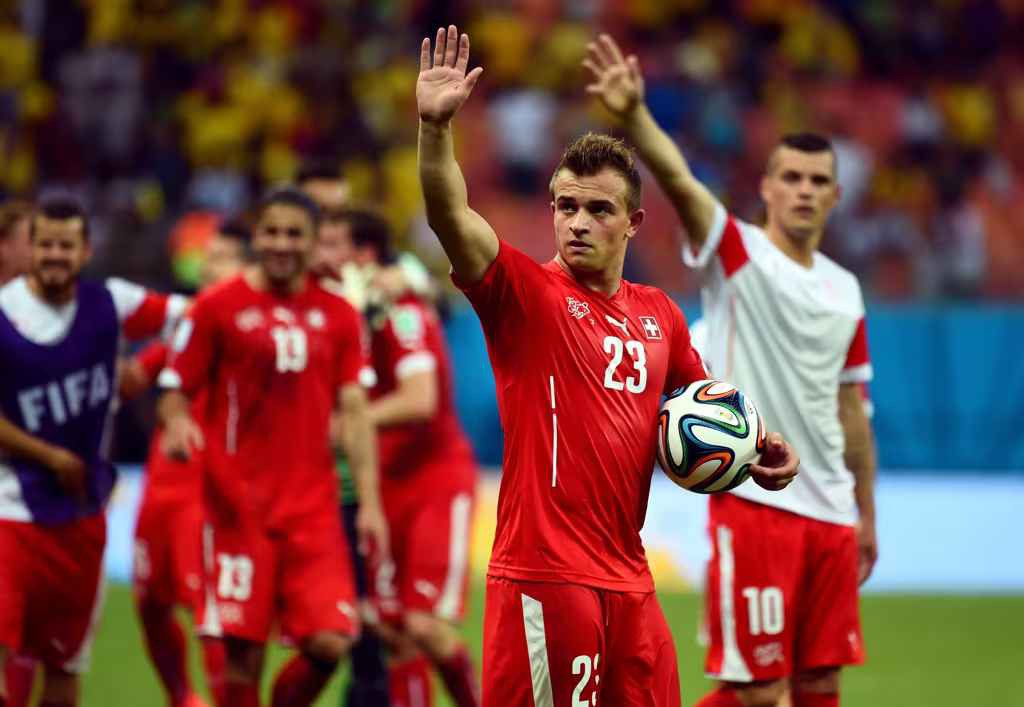
MANAUS, Brazil – In the long and storied history of the FIFA World Cup, certain performances become synonymous with the venues where they occurred. For Switzerland, the city of Manaus-a humid, jungle-bound outpost in the heart of the Amazon-will forever be remembered as the stage where Xherdan Shaqiri transformed from a promising talent into a national icon. On June 25, 2014, under the heavy, moisture-laden air of the Arena Amazônia, Shaqiri delivered a performance for the ages, scoring a hat-trick that secured Switzerland's place in the knockout stages and etched his name into the record books.
The Pressure Cooker in Group E
The context leading up to the clash against Honduras was fraught with tension. Switzerland, coached by the legendary Ottmar Hitzfeld, had experienced a rollercoaster tournament. They had opened their campaign with a last-gasp 2-1 victory over Ecuador but were subsequently dismantled 5-2 by a rampant French side. The heavy defeat to France had left the "Nati" (the Swiss national team) bruised and facing a "win-or-go-home" scenario against a physical and resilient Honduras team.
Adding to the pressure was the environment. Manaus was the most feared venue of the 2014 World Cup. With temperatures soaring above 30°C and humidity levels often exceeding 80%, many European teams had struggled to maintain their intensity in the "Amazonian sauna." Critics wondered if the Swiss, accustomed to the cool air of the Alps, would wilt under the tropical sun. Xherdan Shaqiri, however, had other plans.
Six Minutes of Magic: The Breakthrough
It took only six minutes for Shaqiri to silence the doubters and ignite the Swiss fans in attendance. Operating from his preferred position on the right flank, the then-22-year-old Bayern Munich attacker received a pass, skipped past a defender with his characteristic low center of gravity, and drifted inside.
What followed was a moment of pure individual brilliance. From nearly 25 yards out, Shaqiri unleashed a ferocious, swerving strike with his left foot. The ball took a trajectory that seemed to defy the heavy air, screaming into the far top corner of the net, clipping the underside of the crossbar on its way in. It was a goal of such technical perfection that it was immediately hailed as one of the goals of the tournament. The "Pocket Rocket" had arrived, and Switzerland had the early lead they so desperately needed.
The Drmić-Shaqiri Connection
While the first goal was a solo effort, the remainder of the match highlighted the tactical synergy between Shaqiri and striker Josip Drmić. In the 31st minute, Switzerland caught Honduras on a classic counter-attack. As the Hondurans pushed forward seeking an equalizer, the Swiss broke with pace. Drmić played a perfectly weighted through-ball into Shaqiri's path. Showing immense composure, Shaqiri took one touch to settle himself before slotting the ball calmly past goalkeeper Noel Valladares.
This second goal changed the complexion of the game. It forced Honduras to abandon their defensive shape, creating even more space for the Swiss attackers. Throughout the match, Shaqiri's movement was a constant thorn in the side of the Honduran defense. Despite his diminutive stature, his immense upper-body strength allowed him to hold off much larger defenders, while his explosive pace made him impossible to catch once he turned into space.
A Milestone for the Ages
The historic moment arrived in the 71st minute. Once again, it was Drmić who turned provider, dancing past a defender on the left wing before cutting the ball back into the center of the box. Shaqiri, showing a striker's instinct, timed his run perfectly to meet the ball and side-foot it into the bottom corner.
As the ball hit the net, Shaqiri didn't just celebrate a 3-0 lead; he celebrated a milestone. This was the 50th hat-trick in the history of the FIFA World Cup, a sequence that began in 1930. Furthermore, Shaqiri became the first Swiss player to score a World Cup hat-trick in sixty years, following in the footsteps of Josef Hügi, who achieved the feat during the 1954 tournament hosted on Swiss soil.
The Legacy of the "Alpine Messi"
Shaqiri's performance in Manaus was more than just a statistical anomaly; it was the birth of his reputation as a "big-game player." While his club career would later take him to Inter Milan, Stoke City, Liverpool, and Lyon, his performances for the national team remained consistently elite. The hat-trick against Honduras was the first of many crucial goals he would score in major tournaments, including his famous overhead kick against Poland in Euro 2016 and his repeated heroics against Serbia in subsequent World Cups.
For Switzerland, the 3-0 win propelled them into a Round of 16 match against Lionel Messi's Argentina. Although they would eventually lose that heart-wrenching match in extra time, the 2014 campaign was viewed as a resounding success, largely due to the spark provided by their number 23.
Looking Toward 2026
As the football world prepares for the 2026 World Cup in Canada, Mexico, and the USA, the memory of Shaqiri in Manaus serves as a reminder of the magic the World Cup can produce. For young Swiss players, Shaqiri is the blueprint-a player who combined raw power with technical finesse and the mental fortitude to perform when the stakes were highest and the conditions were most difficult.
Xherdan Shaqiri may have moved on to the twilight of his career in MLS and beyond, but for those who witnessed that humid night in Brazil, he will always be the man who tamed the Amazon with a golden left foot.
Author Profile: Guangzhou Smart Sports Industrial Co., Ltd.