


What materials are used for scaffolding grandstands?
As a supplier of scaffolding grandstands, I've witnessed firsthand the evolution of materials used in their construction. The choice of materials is crucial as it directly impacts the grandstand's durability, safety, and overall performance. In this blog, I'll delve into the various materials commonly used for scaffolding grandstands and explore their unique properties and benefits.
Steel
Steel is one of the most popular materials for scaffolding grandstands, and for good reason. It offers exceptional strength and durability, making it suitable for large-scale and heavy-duty applications. Steel scaffolding can withstand significant loads and is resistant to corrosion, ensuring a long lifespan even in harsh environmental conditions.
One of the key advantages of steel is its versatility. It can be easily fabricated into various shapes and sizes, allowing for customized designs to meet specific project requirements. Steel scaffolding can be quickly assembled and disassembled, making it ideal for temporary structures such as event grandstands. Additionally, steel is a recyclable material, which aligns with sustainable construction practices.
However, steel does have some drawbacks. It is relatively heavy, which can increase transportation and installation costs. Moreover, steel can be prone to rust if not properly treated or maintained. To mitigate these issues, galvanized steel is often used, which provides a protective coating to prevent corrosion.
Aluminum
Aluminum is another commonly used material for scaffolding grandstands, especially for temporary or lightweight applications. It is known for its high strength-to-weight ratio, making it easier to transport and install compared to steel. Aluminum is also resistant to corrosion, which is particularly beneficial in outdoor environments.
One of the main advantages of aluminum is its flexibility. It can be easily bent and shaped, allowing for creative and unique designs. Aluminum scaffolding is also relatively easy to assemble and disassemble, making it a popular choice for events and temporary structures. Additionally, aluminum is a recyclable material, which makes it an environmentally friendly option.
However, aluminum is generally more expensive than steel, which can be a limiting factor for some projects. It also has a lower load capacity compared to steel, so it may not be suitable for large-scale or heavy-duty applications.
Wood
Wood has been used for scaffolding grandstands for centuries and is still a popular choice in some applications. It is a natural and renewable material that offers a warm and inviting aesthetic. Wood is relatively easy to work with and can be easily cut, shaped, and joined.
One of the advantages of wood is its affordability. It is generally less expensive than steel and aluminum, making it a cost-effective option for small-scale or budget-conscious projects. Wood is also a good insulator, which can help to reduce energy costs in some applications.

However, wood has some limitations. It is susceptible to rot, decay, and insect damage if not properly treated or maintained. Wood also has a lower load capacity compared to steel and aluminum, so it may not be suitable for large-scale or heavy-duty applications.
Composite Materials
Composite materials are becoming increasingly popular for scaffolding grandstands due to their unique properties and benefits. Composite materials are made by combining two or more different materials to create a new material with enhanced properties.
One of the advantages of composite materials is their high strength-to-weight ratio. They are often lighter than steel and aluminum, making them easier to transport and install. Composite materials are also resistant to corrosion, rot, and insect damage, which makes them ideal for outdoor applications.
Another advantage of composite materials is their versatility. They can be easily fabricated into various shapes and sizes, allowing for customized designs to meet specific project requirements. Composite materials can also be designed to have specific properties, such as fire resistance or UV resistance.
However, composite materials are generally more expensive than traditional materials such as steel, aluminum, and wood. They also require specialized manufacturing processes, which can increase production costs.
Canopy Materials
In addition to the main structural materials, scaffolding grandstands often require a canopy to provide protection from the elements. There are several materials commonly used for canopies, each with its own unique properties and benefits.
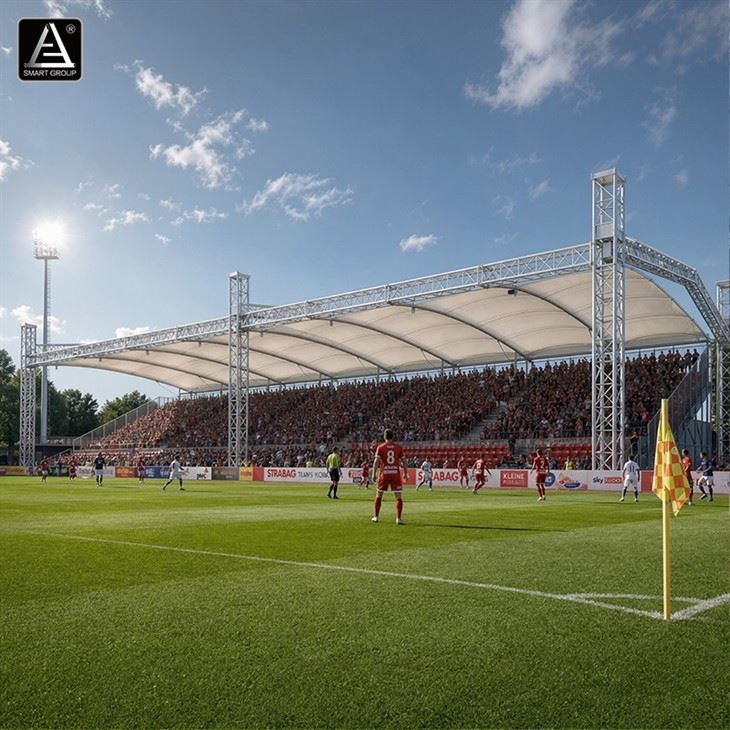
One of the most popular canopy materials is fabric. Fabric canopies are lightweight, flexible, and easy to install. They are available in a variety of colors and patterns, allowing for customized designs to match the overall aesthetic of the grandstand. Fabric canopies are also relatively inexpensive compared to other canopy materials.
Another popular canopy material is polycarbonate. Polycarbonate is a strong and durable material that offers excellent UV protection. It is available in a variety of thicknesses and colors, allowing for customized designs to meet specific project requirements. Polycarbonate canopies are also relatively easy to install and maintain.
For more permanent or high-end applications, glass canopies may be used. Glass canopies offer a sleek and modern aesthetic, and they provide excellent visibility and natural light. However, glass canopies are generally more expensive than fabric or polycarbonate canopies, and they require specialized installation and maintenance.
If you're interested in exploring Stadium Grandstand Seating Canopy, Stadium Grandstand Membrane Structure Canopy, or Outdoor Temporary Roofed Grandstand Seating, we can provide you with detailed information and customized solutions.
In conclusion, the choice of materials for scaffolding grandstands depends on a variety of factors, including the project requirements, budget, and environmental conditions. Steel, aluminum, wood, and composite materials each have their own unique properties and benefits, and the right material will depend on the specific needs of the project. Additionally, the choice of canopy material is also important, as it can provide protection from the elements and enhance the overall aesthetic of the grandstand.
If you're in the market for scaffolding grandstands, I encourage you to contact us to discuss your specific requirements. Our team of experts can help you choose the right materials and design a grandstand that meets your needs and budget. We look forward to working with you to create a safe, durable, and functional grandstand for your next event or project.
References
- "Scaffolding Handbook" by John W. Raftery
- "Construction Materials: Types, Properties, and Selection" by S.K. Duggal
- "Structural Steel Design" by William T. Segui


