Located in Doncaster, England, Eco-Power Stadium is a purpose-built multi-use sports venue best known as the home of Doncaster Rovers FC. The stadium has a capacity of 15,231 spectators and stands at Stadium Way, Lakeside, Doncaster, DN4 5JW. Opened on 17 December 2006 with Doncaster Rovers defeating Huddersfield Town 3–0, the venue was originally known as Keepmoat Stadium, a name used from 2006 to 2022. Its reported construction cost was approximately £32 million.
For football supporters, Eco-Power Stadium is an important part of Doncaster's sporting identity. For stadium developers, architects, government procurement teams, contractors and sports facility investors, however, the venue is also a useful reference for understanding how a modern regional stadium can combine spectator capacity, circulation, commercial functions and multi-purpose event use.

Construction Background and Project Development
The stadium was developed as part of the Lakeside regeneration area in Doncaster, replacing the club's historic Belle Vue ground and creating a modern venue designed for contemporary football and wider sporting activities. The project formed part of a broader effort to establish a new sports and leisure destination, with the stadium becoming the central facility within the development.
Construction took place during the mid-2000s, with the venue completed in time for its December 2006 opening. The approximately £32 million investment covered a purpose-built stadium rather than simply replacing an existing stand. The project incorporated modern spectator circulation, hospitality spaces, media facilities, player areas and operational infrastructure required for professional sports.
The original project's architectural and construction attributions are commonly associated with West Hart Partnership and Shepherd Construction respectively. As historical project information is not consistently reproduced across modern online references, these company attributions should be cross-checked against original project documentation before being used in formal procurement, engineering or technical publications.
Capacity and Grandstand Structure
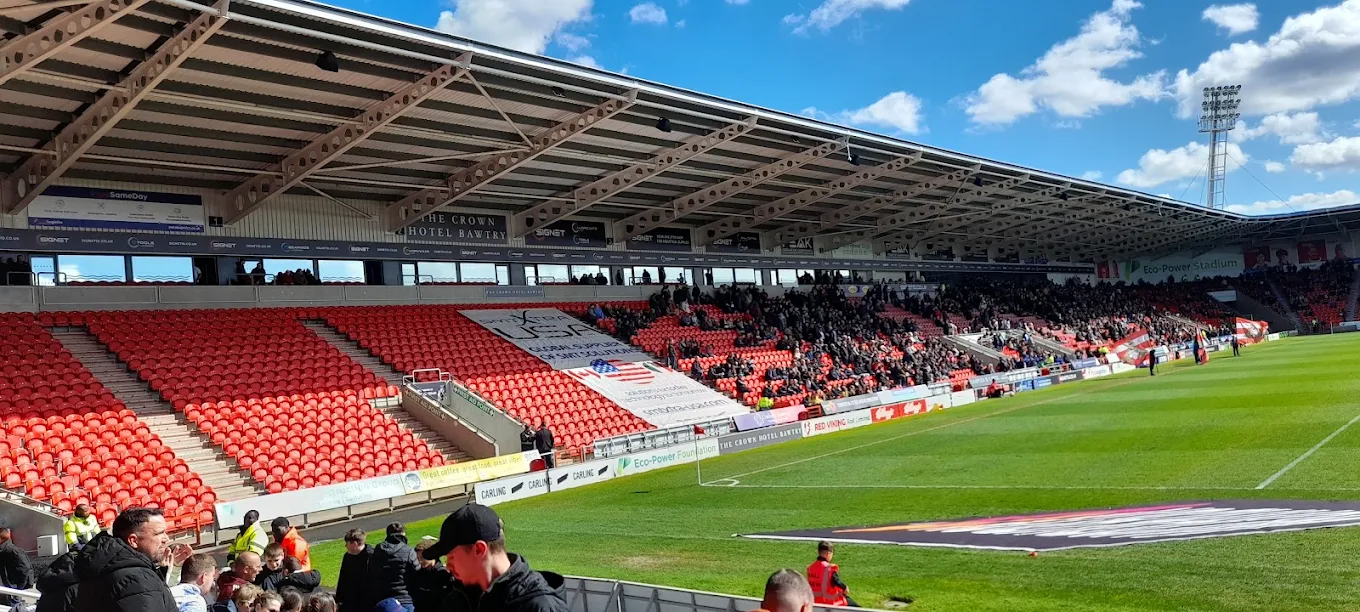
Eco-Power Stadium provides approximately 15,231 spectator places in an all-seater configuration. The stadium is arranged around the football pitch with four principal spectator stands, creating clearly defined viewing areas while supporting hospitality, circulation and operational requirements.
From a stadium construction perspective, an important characteristic is the balance between a relatively compact footprint and a complete professional stadium program. The stands are integrated with entrance areas, concourses, spectator circulation routes, hospitality facilities, media spaces and back-of-house functions.
This type of configuration is highly relevant to new stadium projects. Depending on the site, budget, local regulations and expected attendance, similar principles can be adapted into different capacities, roof systems, stand structures, seating layouts and architectural finishes.
A modern grandstand must address more than seating capacity. Structural performance, crowd movement, accessibility, sightlines, safety, weather protection, maintenance and operational efficiency all need to be considered from the early planning stage.

Major Events and Multi-Purpose Use
Although football is the primary function of Eco-Power Stadium, the venue has also demonstrated its ability to accommodate other major sporting activities. One of its notable roles was as a host venue during the 2013 Rugby League World Cup, showing how a football-focused stadium can support an international sporting event.
The venue has also been used for women's football, youth and international fixtures, community sporting programs and other events. This multi-purpose capability is increasingly important for stadium owners and public-sector investors because it can extend venue utilization beyond regular league matches and strengthen the stadium's wider economic and community role.
For new sports infrastructure projects, flexibility can be a major planning consideration. A stadium designed for football can also be developed to support rugby, athletics-related activities, ceremonies, community programs or temporary events when the structural, circulation and operational systems are properly coordinated.
Doncaster Rovers FC: The Home Club
Doncaster Rovers FC is an English professional football club founded in 1879. The club has a long sporting history in Doncaster and moved to the new stadium during the 2006–07 season, marking an important transition from the historic Belle Vue ground to a modern purpose-built football venue.
The stadium provides the club with professional matchday infrastructure, spectator seating, hospitality areas, player facilities and commercial spaces. At the same time, its multi-use design enables the venue to serve audiences beyond regular Doncaster Rovers fixtures.
For stadium developers, this is an important principle: a modern sports venue should meet the operational needs of its anchor club while maintaining enough flexibility to support additional events and community functions.
What Eco-Power Stadium Means for Stadium Buyers
The value of Eco-Power Stadium as a reference project goes beyond its 15,231-seat capacity. It demonstrates the importance of coordinating grandstands, roofing, spectator seating, circulation, hospitality, structural systems and event infrastructure as one integrated sports facility.
SMART GROUP is a China-based supplier focused on providing one-stop integrated sports facility solutions for global customers. For stadium owners, design companies, contractors and government sports projects, SMART GROUP can support the planning and supply of grandstands, stadium seats, steel and membrane structures, retractable seating and other sports venue infrastructure.
A modern stadium project requires more than seats around a football pitch. It requires coordinated engineering, reliable structural performance, efficient installation and solutions adapted to local environmental conditions, building requirements and operational objectives.
Eco-Power Stadium in Doncaster provides a practical reference for organizations considering a new football stadium, municipal sports center or multi-purpose arena. Its development highlights the importance of capacity planning, stand configuration, spectator experience, multi-purpose functionality and long-term facility utilization.
For international sports infrastructure projects, SMART GROUP brings together preliminary planning, engineering coordination, manufacturing, logistics and installation support to help clients turn stadium concepts into practical, integrated sports facilities.
Author Profile: SMART GROUP - Global Sports Facility Solution Provider