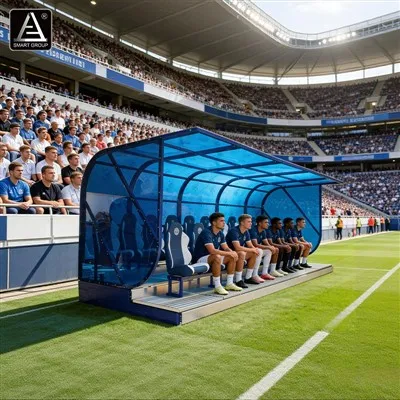
Both FIFA and the AFC lay out stringent specifications for team benches (dugouts) in their latest stadium design and tournament manuals (such as the FIFA Football Stadiums Guidelines and AFC Stadium Regulations). The core objectives of these regulations are to ensure the comfort and safety of team delegation members, prevent sightline obstructions for spectators and broadcasters, and enhance protection against thrown objects and extreme weather.
Below are the latest specific requirements and technical standards regarding seating dimensions, sightlines, and shelters:
1. Seating Capacity and Dimensions
· Seating Capacity:
· AFC Regulation: Two sheltered team benches must be provided next to the field of play. Each bench must accommodate at least 20 people with individual seats. If the official team delegation size for a specific competition requires more, the capacity must be increased accordingly.
· Fourth Official's Bench: Located precisely between the two team benches, a separate sheltered bench accommodating at least 3 people with a working desk must be provided for the fourth official and match technicians.
· Seat Performance and Style:
· Individual Backrests: Benches must feature individual seats with backrests. Continuous bench seating without backrests is strictly prohibited. Modern high-category stadiums typically utilize ergonomic, UV-resistant, and durable race-style "bucket seats."
· Portability (FIFA Recommendation): In its latest guidelines, FIFA recommends that the entire dugout structure and its seats be portable to facilitate pitch maintenance, grass mowing, and multi-purpose venue conversion during non-match periods.
· Spatial Clearance: The center-to-center distance between seats and the legroom in front must be generous to ensure players and coaches can move in and out quickly and comfortably without collisions, even when wearing football boots and heavy jackets.
2. Sightline Obstruction Regulations
Because the physical height and positioning of dugouts can easily create visual blind spots for spectators in the front rows and for broadcast cameras, both organizations enforce strict limitations:
· Unobstructed Sightline Principle:
· Core Clause: All dugout facilities installed at the Field of Play (FOP) level must not obstruct the view of spectators in the stands.
· To guarantee the sightline quality for spectators in the lower main stand (i.e., meeting the "C-value" requirements specified by FIFA), the highest point of the dugout canopy must remain below the sightline of the front-row spectators.
· Sunken / Recessed Dugout Design (The Modern Standard):
· To resolve sightline obstructions without sacrificing the height of the dugout (ensuring coaches can stand and direct the game), FIFA strongly encourages and modern professional stadiums widely adopt sunken dugouts. The floor of the team bench is recessed into the ground (usually by 0.5m to 1m), effectively "hiding" standing coaches, seated players, and the canopy structure below the horizontal line of sight of the first-row spectators.
· Distance from the Touchline:
· AFC Regulation: The dugout structure must be positioned at least 5 meters away from the pitch touchline.
· FIFA Standard: International "Category A" match venues generally require a clearance of 4 to 5 meters. This distance ensures the safety of the assistant referee (linesman) while running and prevents the dugout's physical volume from obstructing the main pitch-centre broadcast camera when capturing action near the touchline.
3. Canopy and Shelter Requirements
· All-Weather Protection (Rain, Wind, and Sun):
· The canopy must possess high weather resistance, fully covering all seats and personnel to protect them from heavy rain, strong winds, and direct solar UV radiation.
· Anti-Impact Safety and Transparent Materials:
· AFC Core Requirement: The team benches must be protected by a transparent "Plexiglas-type shell" (or high-strength polycarbonate).
· Dual Functionality: 1. Safety: The shell must have excellent impact resistance (explosion-proof/shatter-proof) to protect the coaches and players from objects thrown by spectators in the stands. 2. Transparency and Visual Optimization: Utilizing highly transparent, anti-glare materials ensures that even if the canopy sits slightly above the stand level due to site constraints, it minimizes physical visual oppression for the spectators behind it, the fourth official, and the broadcast angles.
Summary: Implementation Standards for Modern Elite Stadiums
In newly built or upgraded elite professional football stadiums (such as those meeting FIFA Category 4, the AFC Asian Cup, or the AFC Champions League Elite standards), the standard configuration for team benches is: a sunken dugout slot + at least 20 UV-resistant individual race bucket seats + an all-enclosing, high-strength, shatter-proof, fully transparent polycarbonate canopy. Additionally, the entire structure is often equipped with concealed wheels at the base, allowing it to be rolled off the field quickly after a match.
Author Profile: Guangzhou Smart Sports Industrial Co., Ltd.