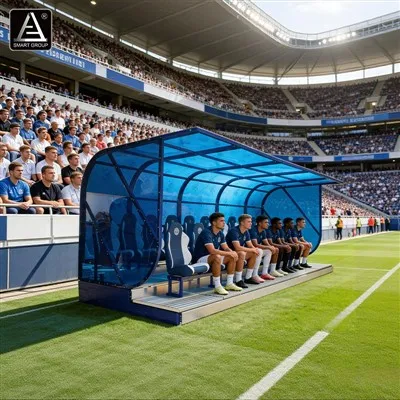
Nestled in the heart of Shepherd's Bush, West London, the MATRADE Loftus Road Stadium (located at South Africa Road, London, W12 7PA, England) stands as one of English football's most historic, intimate, and atmospheric venues. As the proud home of Queens Park Rangers (QPR), this compact arena has captured the imagination of football enthusiasts for generations. However, beyond its famous matchday roar and passionate "Hoops" supporters, Loftus Road serves as a fascinating case study in stadium architecture, space optimization, and structural engineering. For sports stadium builders, architectural design companies, and government sports project procurement buyers worldwide, examining legendary venues like Loftus Road yields invaluable insights into modern sports facility development. This is where SMART GROUP, a premier Chinese supplier specializing in global one-stop comprehensive sports facility solutions, bridges the gap between classic venue design principles and cutting-edge manufacturing excellence.

A Century of Evolution: Construction History and Background
The origins of the site date back to its inauguration in 1904, when it was initially utilized by an amateur side named Shepherd's Bush FC. Following the requisition of their previous ground at Park Royal by the military during World War I, Queens Park Rangers permanently relocated to Loftus Road in 1917. At that time, the ground consisted of little more than an open field with a modest pavilion.
The stadium's structural journey reflects decades of phased engineering and adaptive growth. In 1938, a major milestone was achieved when a specialized construction firm, Framed Structures Ltd, erected a new covered terrace at the Loftus Road end, expanding the venue's capacity significantly. Between 1968 and 1981, the venue underwent a comprehensive multi-phase reconstruction program that transformed it into one of the most advanced compact stadiums in Britain. This era included the construction of a new stand along Ellerslie Road in 1972, followed by extensive redevelopment at the School End and Loftus Road ends.
Though modern safety regulations and seating conversions have optimized its layout, the stadium's historical record attendance reached an astonishing 35,353 spectators during a classic clash between QPR and Leeds United on April 27, 1927 (incorporating historical standing configurations). For modern stadium construction firms and design consultants, studying this developmental timeline highlights the necessity of modular, scalable, and durable engineering-qualities that SMART GROUP delivers through its comprehensive international sports infrastructure supply chain.

Architectural Blueprint, Stand Structure, and Capacity Breakdown
Today, MATRADE Loftus Road Stadium accommodates an all-seater and rail-seating capacity of 18,439, expertly configured within a tightly constrained urban footprint. Its structured capacity breakdown includes:
VIP Seats: 312 premium hospitality seats designed for executive matchday networking and luxury viewing.
Press Seats: 99 dedicated media and press positions equipped with modern broadcasting infrastructure.
Away Section: 2,500 secure seats allocated to visiting supporters.
Floodlighting: A robust 800 lux professional lighting system ensuring optimal broadcast clarity and evening match safety.
Architecturally, Loftus Road is globally celebrated for its fully enclosed, bowl-like configuration. Unlike many suburban stadiums with open corners, all four distinct stands-The Bhatia Stand (North/South Africa Road, housing dressing rooms and executive suites), The Stanley Bowles Stand (Ellerslie Road), The Loft (Loftus Engineering Stand, a two-tier vocal stronghold), and The Achilleus Security Stand (School End)-meet seamlessly at the corners with zero gaps. This unique closed architecture traps crowd noise, creating the legendary acoustic intensity that gives QPR a formidable home advantage.
Furthermore, the stadium integrates modern safety and spectator innovations, such as rail seating blocks in the lower tiers to accommodate safe standing. For municipal procurement authorities and stadium design firms, replicating such acoustic efficiency and spatial optimization requires top-tier seating systems, structural steelwork, and safety barriers-core offerings in SMART GROUP's extensive product catalog.

Multi-Functional Legacy and Global Event Hosting
Beyond its permanent identity as the fortress of Queens Park Rangers, MATRADE Loftus Road Stadium has demonstrated remarkable multi-functional adaptability. Over the decades, it has hosted high-profile international friendlies featuring the Australian national team, served as a temporary home ground for rugby union giants London Wasps (1996–2002), and accommodated Premier League side Fulham FC (2002–2004) and AFC Wimbledon (2020) during their respective stadium transitions.
Notably, the venue stepped onto the international stage in 2015 by hosting the prestigious Saudi Super Cup fixture between Al Hilal and Al Nassr, as well as staging the deeply moving Game 4 Grenfell charity match in 2017. These diverse events underscore a vital lesson for government sports project procurement planners: modern sports facilities must be engineered for multi-sport versatility, rapid turnaround times, and robust structural durability.

Partnering for the Future with SMART GROUP
As urban sports venues continue to evolve, stadium builders, engineering consultants, and government procurement agencies face mounting pressure to deliver sustainable, cost-effective, and high-performance sports infrastructure. Whether you are planning a boutique community arena or a major professional stadium upgrade, partnering with an experienced global supplier is essential.
SMART GROUP stands ready as your trusted partner from China, offering world-class, one-stop comprehensive sports facility solutions. From advanced spectator seating, telescopic grandstands, and professional turf systems to specialized sports lighting and venue maintenance equipment, SMART GROUP combines manufacturing precision with international engineering standards. Contact SMART GROUP today to discover how we can help bring your next stadium construction or municipal sports project to life with unmatched efficiency and quality.
Author Profile: SMART GROUP - Global Sports Facility Solution Provider