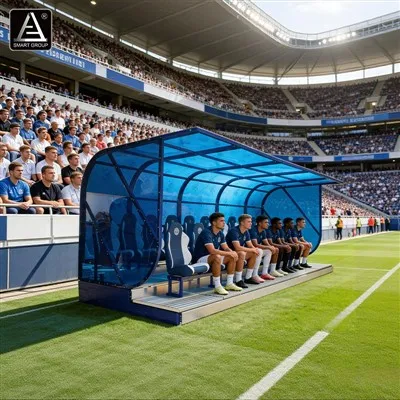
When exploring iconic sporting landmarks across the United Kingdom, few venues blend deep-rooted community passion with remarkable structural evolution quite like ProAmpac Stadium, universally recognized by fans, municipal authorities, and sports historians as Sincil Bank Stadium. Located in the historic cathedral city of Lincoln, England (Address: Sincil Bank Stadium, Lincoln, Lincolnshire, LN5 8LD), this legendary arena has served as the proud, beating heart of Lincoln City FC ("The Imps") since the late nineteenth century.
For dedicated football supporters, it is a sacred home of unforgettable matchday drama and lifelong memories. However, from the strategic perspective of stadium builders, architectural design firms, and government sports project procurement officers, Sincil Bank Stadium presents a fascinating case study in adaptive engineering, continuous multi-era renovations, and infrastructure longevity. At SMART GROUP, a leading global provider of one-stop comprehensive sports facility solutions from China, we view venues like Sincil Bank not merely as football pitches, but as evolving engineering masterpieces that demand the highest standards of innovation, safety, structural integrity, and operational efficiency.

A Storied Heritage: From 1895 to Modern Engineering
The history of Sincil Bank is a testament to unwavering community resilience and continuous architectural growth. Officially inaugurated on 14.09.1895 with a landmark inaugural fixture between Lincoln City and Woolwich Arsenal, the ground successfully replaced the club's earlier John O'Gaunts playing grounds. Affectionately nicknamed "The Bank" by generations of devoted fans, the stadium has also borne several historical and commercial monikers over the decades, including the 12th Imp Sincil Bank Stadium, The Gelder Group Sincil Bank Stadium, and LNER Stadium.
Throughout its storied existence, the venue has witnessed legendary sporting encounters. None surpassed the attendance-heavy historic clash against Derby County in November 1967, which drew a record-shattering attendance of 23,196 spectators packed tightly into the old terracing. Today, following modern safety regulations, stadium modernization, and all-seater transformations, the venue accommodates an intimate, vibrant capacity of 10,669 seated guests.

Construction History, Architecture, and Structural Evolution
The architectural timeline of Sincil Bank is marked by an extraordinary series of strategic renovations and rebuilding programs across multiple generations: 1898, 1899, 1901, 1902, 1925, 1931, 1947, 1948, 1953, 1962, 1977, 1987, 1992, 1994, 1995, and 2000.
In its early years, construction relied heavily on timber stands and basic perimeter fencing, which unfortunately suffered from fire hazards and weather wear-leading to crucial rebuilding phases in the 1920s and 1930s. Following post-World War II repairs, the late twentieth century brought rigorous safety mandates and modern engineering standards. The comprehensive rebuilding programs between 1987 and 1995 successfully replaced aging wooden structures with modern steel-framed stands, reinforced concrete, and modern spectator amenities.
The stadium's current stand layout showcases functional, spectator-focused engineering:
The GBM Stand (Main Stand): Housing the majority of home supporters, family seating blocks, and community facilities, redeveloped significantly in the mid-1990s.
The Greenlinc Renewables (St Andrew's) Stand: Accommodating executive hospitality suites, media press boxes, club offices, and administrative headquarters.
The Stacey West Stand: Completing the all-seater transition, optimizing spectator safety, and ensuring unobstructed sightlines.

Strategic Insights for Stadium Builders, Designers, and Government Procurement Officers
For modern architectural design firms, civil engineering contractors, and municipal sports procurement teams, Sincil Bank highlights vital lessons in modern venue lifecycle management:
Modular Adaptability: Historic grounds must continuously upgrade hospitality suites, fan engagement zones, and digital infrastructure without compromising structural safety.
Safety Compliance & Crowd Flow: Transitioning from traditional terracing to secure, all-seater configurations requires advanced engineering in egress design, barrier safety, and structural load calculations.
Sustainability and Multipurpose Utility: Contemporary sports infrastructure must integrate energy-efficient LED lighting, eco-friendly building materials, and flexible community spaces that generate sustainable non-matchday revenue streams.

SMART GROUP: Empowering Global Sports Infrastructure Solutions
As municipal governments, stadium developers, and engineering firms seek world-class partners for sports facility construction and modernization, SMART GROUP stands ready to deliver excellence. As a premier Chinese supplier specializing in comprehensive, one-stop sports facility solutions, we bridge the gap between ambitious architectural concepts and flawless global execution.
Our extensive manufacturing and supply portfolio covers every component required for modern sports venues:
Advanced Seating Systems: Ergonomic stadium seats, telescopic retractable stands, and VIP hospitality seating designed for maximum durability, weather resistance, and spectator comfort.
Turnkey Engineering & Steel Structures: Precision-manufactured roof trusses, modular grandstands, structural framing, and safety barriers fully compliant with international building codes.
Turf & Facility Equipment: High-performance artificial and natural turf maintenance systems, professional sports floodlighting, and digital electronic scoreboards.
Whether you are a government sports project procurement officer planning a municipal arena, an architectural design firm seeking reliable manufacturing partners, or a general stadium builder looking for cost-effective, high-quality modular solutions, SMART GROUP provides unparalleled end-to-end expertise. We transform visionary blueprints into safe, sustainable, and awe-inspiring sporting fortresses.
Partner with SMART GROUP today, and let us build the future of global sports infrastructure together.
Author Profile: SMART GROUP - Global Sports Facility Solution Provider