In the construction of modern stadiums and school grandstands, seating installation is not only crucial for spectator comfort and safety, but also a key factor in project cost control and long-term operation and maintenance. Many owners and contractors often find themselves choosing between steel structures and concrete stands, while also debating the fixing method: should they go with Floor Mounted or Riser Mounted?
From the dual perspectives of engineering cost and architectural practicality, this article provides a deep dive into the pros, cons, and total life-cycle cost comparisons of these two mounting methods across different stand materials.
What Are Floor Mounted and Riser Mounted Seating?
Before diving into the comparison, let's clarify the definitions of these two core industry terms:
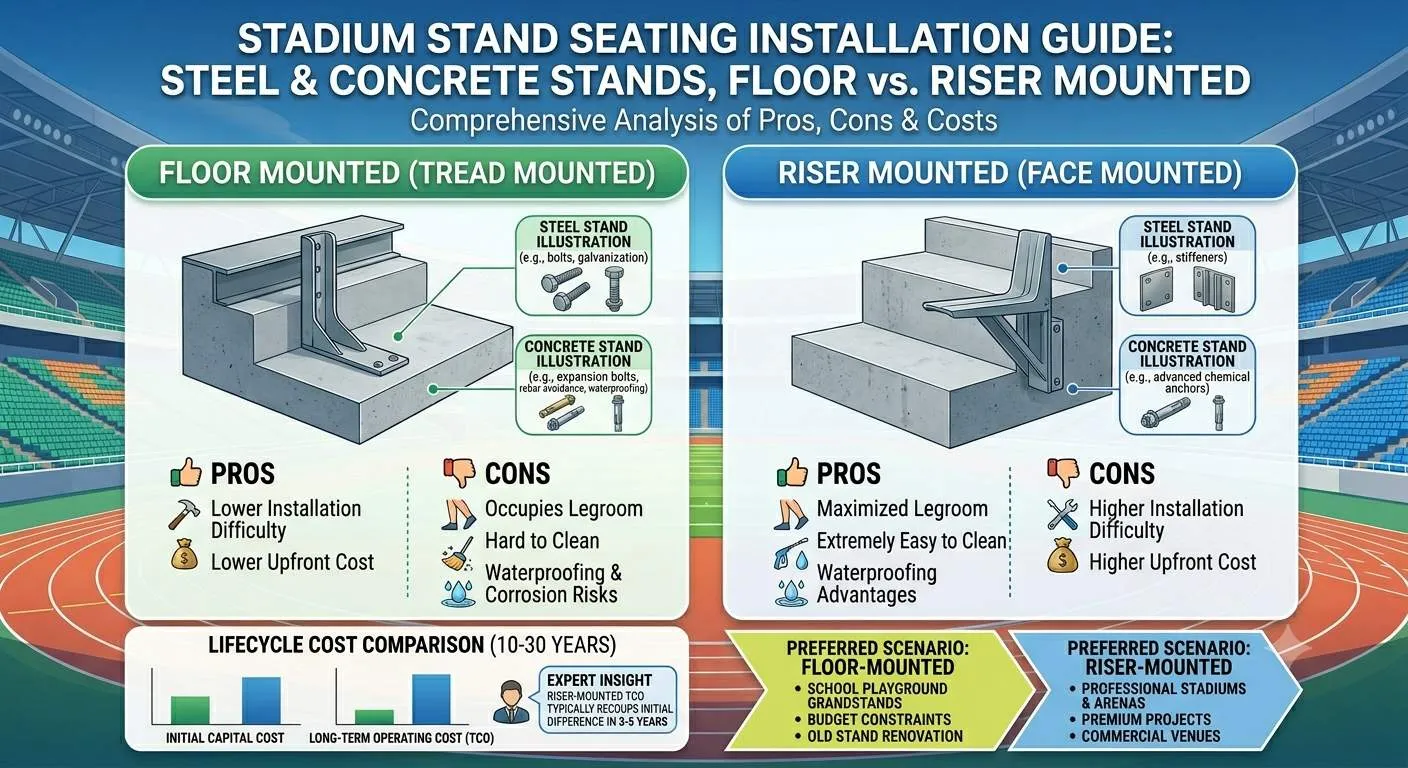
Floor Mounted (or Tread Mounted): The brackets are fixed directly onto the horizontal tread surface of the stand (the flat area where spectators place their feet).
Riser Mounted (or Face Mounted): The brackets are fixed onto the vertical face of the stand (the front riser of the step).
How Steel vs. Concrete Stands Impact Installation
The underlying material of the grandstand dictates the installation details and the choice of anchors:
1. Steel Grandstands
Characteristics: Fast construction speed and lightweight.
Installation Considerations: Drilling and bolting can easily damage anti-corrosion coatings or hot-dip galvanized layers. Under load, steel structures exhibit slight flexible vibration, requiring high shear resistance and anti-loosening capabilities from the seating connectors.
2. Concrete Grandstands
Characteristics: Strong structural integrity, long lifespan, and excellent vibration dampening.
Installation Considerations: Expansion bolts or chemical anchors must be used. Drilling must precisely avoid internal rebar structures, and the original waterproofing layer of the stand must never be compromised.
Floor Mounted vs. Riser Mounted: A Comprehensive Comparison
To help project designers and procurement managers evaluate more intuitively, here is a comparison matrix of the two fixing methods:
| Dimension | Floor Mounted | Riser Mounted |
| Installation Difficulty | Lower. Mature technology, simple positioning, and relatively low technical requirements for on-site installers. | Higher. Requires precise alignment with the vertical plane. The leverage torque is large, demanding strict accuracy in installation and drilling. |
| Space & Comfort | Slightly occupies legroom; visually, there are more brackets and posts on the floor. | Maximized Legroom. The bottom of the seat is completely suspended, offering a clearer, more modern visual aesthetic. |
| Cleaning & Maintenance | Difficult to Clean. Dust, fallen leaves, and beverage stains easily accumulate around the seat legs, creating typical dead zones for sweeping. | Extremely Easy to Clean. The floor is completely unobstructed, allowing for efficient cleaning using high-pressure water guns or modern sweepers. |
| Waterproofing & Anti-Corrosion | Bolt holes are located on the horizontal surface. Poor sealing easily leads to water accumulation and leakage, potentially causing steel rust or internal rebar corrosion in concrete. | Bolt holes are located on the vertical face, resulting in minimal water accumulation and providing natural advantages in drainage and leak prevention. |
Total Lifecycle Cost Comparison (Initial Cost vs. TCO)
When planning a project budget, experienced procurement managers look far beyond the "initial purchase price." Grandstand seating costs must be calculated across a 10 to 30-year venue operation period.
1. Upfront Capital
Floor Mounted Wins: Floor-mounted seats utilize common standard parts, leading to lower material and processing costs. Because the construction is straightforward, the installation speed is typically 15% to 25% faster than riser mounting, effectively reducing the project timeline and labor costs.
Riser Mounted is Pricier: Riser-mounted brackets require higher bending load capacity to withstand the leverage torque when spectators sit down and stand up, which means higher steel consumption. Concrete stands require higher-grade chemical anchors, while steel structures require stiffeners or thickening on the vertical face. Its initial comprehensive cost is usually about 20% higher than floor mounting.
2. Total Cost of Ownership (TCO)
Riser Mounted Pulls Ahead:
Cleaning Labor: Because there are no dead zones on the floor, cleaning efficiency with riser-mounted seats can be improved by over 40%. For a stadium with tens of thousands of seats, the long-term labor savings are staggering.
Hardware Wear and Tear: Floor-mounted anchors on horizontal surfaces are more susceptible to pedestrian traffic and rainwater erosion. Annual inspections reveal a much higher probability of loose bolts requiring reinforcement or replacement compared to riser-mounted ones.
Expert Insight: Many owners opt for floor mounting to save 20% on the initial seating installation budget, neglecting the cleaning and maintenance costs over decades of stadium operations. The high efficiency and low wear-and-tear of riser-mounted seats typically recoup the initial price difference within 3 to 5 years of venue operation.
Scenario Selection: Which One Should You Choose?
Based on project characteristics, we offer the following precise recommendations:
Scenarios where "Floor Mounted" is preferred:
School playground grandstands or small static stands with severe budget constraints.
Renovation projects for old stands where the riser height is insufficient to meet the fixed dimensions of riser-mounted brackets.
Temporary, demountable, and fully transportable steel structure grandstands.
Scenarios where "Riser Mounted" is preferred:
Medium-to-large professional stadiums and arenas that have strict requirements for aesthetics, premium feel, and spectator legroom.
Commercial venues with frequent operations and tight cleaning schedules (e.g., home stadiums for professional clubs with dense match schedules).
Outdoor steel grandstands in rainy regions; riser mounting drastically reduces the risk of structural rust caused by water accumulation in bolt holes.