In stadium construction and renovation projects, stadium seating systems are one of the most critical facilities that directly affect spectator experience, operational cost, and long-term venue efficiency. For schools, stadium contractors, and event organizers, one of the most common questions in the procurement stage is:
What types of stadium seating are available, and what scenarios are they suitable for?
From a Google SEO perspective, high-frequency search terms such as "stadium seats types," "sports seating solutions," and "bleacher seating systems" all reflect a core decision-making need: how to choose the right seating system. This article provides a clear breakdown of the main types of stadium seating and their application scenarios from a buyer's point of view.
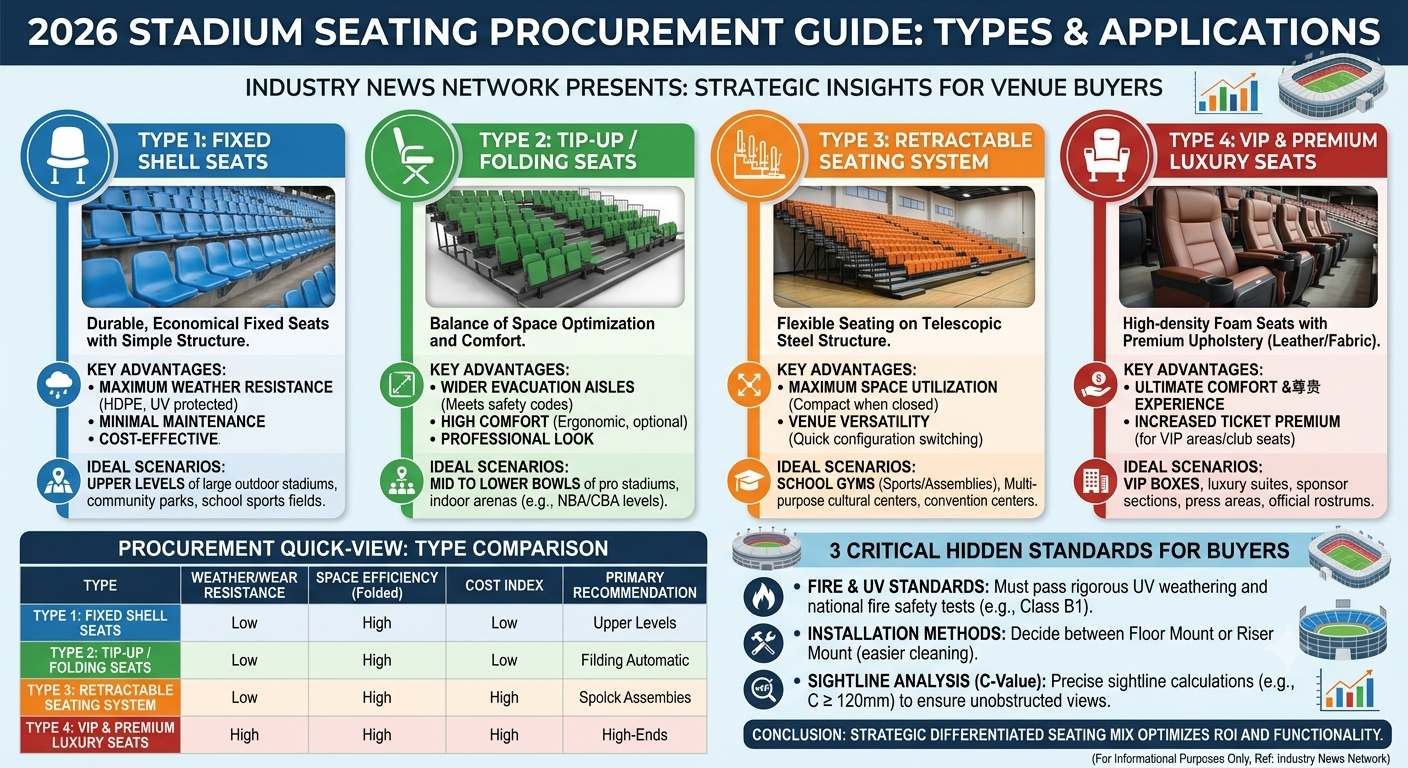
Fixed Stadium Seats
Fixed stadium seats are one of the most widely used professional seating solutions. They are typically anchored to concrete steps or metal structures and are not movable.
Key Features:
Highly stable structure with strong impact resistance
Long service life (typically 10–20 years)
Customizable colors, numbering, and logos
Low maintenance cost
Application Scenarios:
Professional football or soccer stadiums
Large-scale sports arenas
Government-funded public sports facilities
Venues requiring permanent spectator seating
Procurement Insight:
For projects focused on long-term operation and high-frequency use, fixed seating usually delivers the highest return on investment (ROI).
Portable / Removable Seating
Portable seating is usually installed on modular bleacher systems and can be easily moved or dismantled, offering high flexibility.
Key Features:
Flexible configuration for different layouts
Quick installation and removal
Ideal for multi-purpose venues
Suitable for temporary events
Application Scenarios:
School multi-purpose gymnasiums
Indoor training facilities
Temporary sports events
Exhibition and event centers
Procurement Insight:
For multi-purpose venues, portable seating significantly improves space utilization and is a popular choice in school procurement projects.
Telescopic Bleacher Seating
Telescopic seating systems are one of the fastest-growing stadium seating solutions. They can be extended or retracted via manual or electric operation.
Key Features:
Space-saving design (retractable system)
Manual or motorized operation
Compatible with plastic seats or padded seats
High level of automation
Application Scenarios:
School sports halls
Indoor basketball or badminton courts
Multi-purpose event halls
Training and competition integrated facilities
Procurement Insight:
For venues with limited space but multiple functions (sports, performances, conferences), telescopic bleachers are often the optimal solution.
Bench / Bleacher Seating
Bench-style seating is a cost-effective solution featuring continuous seating boards made of plastic or aluminum.
Key Features:
- Low cost and high cost-performance ratio
- Simple installation
- Easy maintenance
- High seating density
Application Scenarios:
- Primary and secondary school playground stands
- Community sports facilities
- Training fields
- Small-scale sports venues
Procurement Insight:
This solution is ideal for budget-sensitive projects requiring basic spectator seating.
Cushioned / VIP Stadium Seats
Padded seats are designed for maximum comfort and are commonly used in premium or VIP seating areas.
Key Features:
- High comfort level
- Premium appearance suitable for branding
- Customizable folding structure and cup holders
- Ideal for VIP sections
Application Scenarios:
- VIP areas in professional stadiums
- High-end sports clubs
- Concert venues
- Commercial sports events
Procurement Insight:
For commercially operated venues, cushioned seating can significantly increase ticket pricing and hospitality value.
PP Plastic Stadium Seats
PP (polypropylene) injection-molded seats are among the most widely used stadium seating types worldwide.
Key Features:
- UV-resistant and weatherproof
- One-piece injection molding design
- Customizable numbering and branding
- Long lifespan (10–20 years)
Application Scenarios:
- Standard stadium stands
- Schools and public sports facilities
- Outdoor football and athletics fields
- Medium to large-scale sports events
Procurement Insight:
PP seats are a universal solution suitable for over 80% of standard stadium projects.
Key Factors in Procurement Decision-Making
Based on search behavior from stadium buyers, key decision factors typically include:
- stadium seating durability
- sports seating cost
- bleacher seating installation
- stadium seat supplier reliability
- outdoor UV resistance
- modular stadium seating systems
Therefore, when selecting stadium seating types, buyers should consider more than just price. Key factors include:
- Venue usage frequency
- Multi-purpose functionality
- Budget and maintenance cost
- Environmental conditions (indoor or outdoor)
- Operation model (public or commercial)
Conclusion
Choosing stadium seating is essentially a comprehensive decision involving space efficiency, usage scenarios, and investment return. For buyers, understanding the differences between seating types can significantly reduce long-term operational costs and improve overall venue value.
Whether it is fixed seating, telescopic systems, or cost-effective bench seating, the key is not choosing the most expensive option, but selecting the solution that best matches the functional requirements of the venue.
Author Profile: Guangzhou Smart Sports Industrial Co., Ltd.